EA-Logo-RGB-Master_Yellow-Dark-Grey-Black


Currency

Cart 0

SIGN UP FOR $10 OFF YOUR FIRST ORDER

Sorry, looks like we don't have enough of this product.

Pair with
Estimate shipping
Add order notes
Is this a gift?
Subtotal Free
View cart
Shipping, taxes, and discount codes are calculated at checkout

Your Cart is Empty

Home / Lighting / Driving & light bars
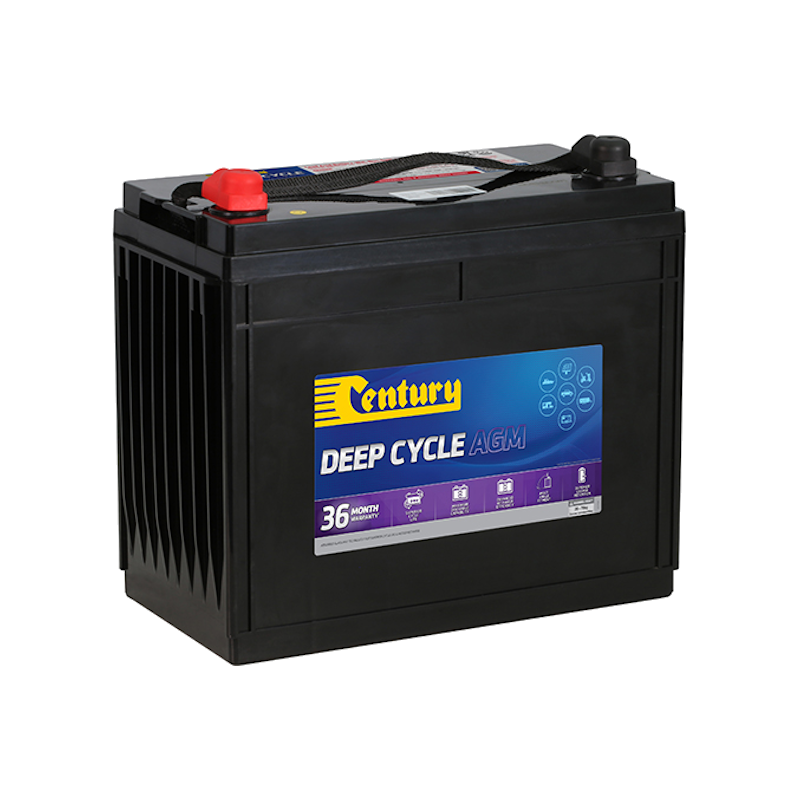
Century C12-140XDA 140Ah 12V AGM deep cycle battery, sealed black case with recessed rope carry handles and M8 insert terminals in D polarityBattery terminal line drawing showing a threaded insert in section with its bolt alongside, dimensioned for reference – Century batteryBattery top-view polarity diagram for a six-cell 12 volt battery with positive terminal location marked – Century battery

Century

C12-140XDA AGM Deep Cycle Battery — 12V 140Ah

148145

Century 140Ah 12V sealed AGM deep-cycle battery with M8 insert terminals, 36-month warranty and 40.2A max charge rate for caravan, 4WD and off-grid use.

$750.00

4 interest-free payments of $187.50 with
or finance your build with
We accept
Fits caravan house-battery compartments, 4WD canopy and under-tray dual-battery setups, marine deep-cycle positions and off-grid solar storage banks within the 340 × 173 × 280mm envelope.

Shipping & collection

Worldwide shipping available*
In-store pickup
Professional installation available

*Shipping is calculated at checkout based on your location. Some products can't be delivered to every address.

A 140Ah sealed AGM deep-cycle battery that powers caravan house loads, 4WD dual-battery setups, marine systems and off-grid solar banks through hundreds of discharge cycles. Runs a 12V fridge, LED lighting, water pumps, inverters up to around 1,200W and USB charging without topping up water or sitting dead flat overnight. Fits under-tray, canopy, caravan battery-box and marine installations in the 340 × 173 × 280mm footprint.

Sealed in an ABS case with integrated rope carry handles, M8 insert terminals in D polarity (positive at right) and central venting with flame arrestors. Internal resistance sits around 4mΩ and the pack handles 1,400A for a 5-second short burst. Weighs 41.5kg. Mounts upright or on its side up to 90° off vertical, never inverted or end-mounted.

Pair it with a DC-DC charger sized at or below the 40.2A max charge rate (a 25-40A unit suits). Float voltage runs 13.6 to 13.8V at 25°C; never trickle-charge with an automotive bench charger that runs higher or you'll gas the cells. This is a deep-cycle plate design, not a starter battery, so pair it alongside a cranking battery via DC-DC rather than wiring in parallel.

  • Sealed AGM — zero spill, zero maintenance, mounts up to 90° off vertical
  • M8 insert terminals — accepts ring-lug cable up to 70mm² without adapters
  • Rope carry handles — moves a 41.5kg battery safely between hands
  • Deep cycle plate design — holds up to repeated 50% discharge, around 1,500 cycles
  • Low internal resistance — 4mΩ delivers 1,400A for inverter start surges
  • Flame arrestor vent — safe to mount inside caravan or canopy battery boxes

Electrical

Capacity: 140Ah at C20

Voltage: 12V DC

Max discharge: 1,400A (5 sec)

Max charge current: 40.2A

Float voltage: 13.6-13.8V at 25°C

Internal resistance: ~4mΩ

Self-discharge: <3% per month at 25°C

Chemistry

Type: Sealed AGM

Case: ABS (UL94-HB)

Cells: 6

Operating range

Discharge temperature: -20°C to 60°C

Charge temperature: 0°C to 50°C

Terminal

Type: M8 insert

Polarity: 12V D (positive at right)
Length340mm
Width173mm
Height280mm
Height over terminals287mm
Weight41.5kg

Mount upright, on its side or at any angle up to 90° off vertical. Never invert or end-mount. Secure the battery in a vibration-dampened battery box or hold-down tray so it cannot shift under load. Keep clearance around the central vent for airflow.

Torque M8 terminal bolts to 8-10 Nm with a stainless washer under each lug. Overtightening cracks the insert, undertightening cooks the lug.

Charge from a DC-DC charger set to an AGM profile with 14.4-14.7V bulk and 13.6-13.8V float, sized at or below the 40.2A max charge rate. Standard automotive bench chargers that run at a higher voltage will gas the cells and void the warranty.

If mounting under the bonnet, use a heat-shielded box and keep ambient under 50°C. AGM batteries lose cycle life rapidly above 40°C sustained.

Fits caravan house-battery compartments, 4WD canopy and under-tray dual-battery setups, marine deep-cycle positions and off-grid solar storage banks within the 340 × 173 × 280mm envelope.
12V DC house systems
Dual-battery setups when paired via a DC-DC charger
Caravan, camper trailer and canopy battery boxes
Marine house (lighting, pumps, electronics) and trolling motor banks
Off-grid solar storage up to the 40.2A charge rating
Not for engine cranking, this is a deep-cycle plate design and not a starter battery
Not for 24V series stacking unless each cell voltage is matched and monitored
Not for installation under a hot engine bay without heat shielding

Q: What does AGM actually mean?
A workshop-tested lead-acid battery with the electrolyte soaked into a fibreglass mat between the plates instead of sitting as free liquid. No spills if it tips, no gas venting under normal use, and much better vibration tolerance than a flooded battery. Trade-off: AGM costs more per Ah than flooded, and over-charging damages it faster.

Q: What does C20 mean when the label says 140Ah?
140Ah at C20 means the battery delivers 7A for 20 hours before voltage drops below cutoff. Draw it harder (10A for 5 hours) and you get less than 140Ah total. Draw it gently (1A over 140 hours) and you can get slightly more. The C20 figure is the reference point manufacturers use for comparison.

Q: Can I use this as a starting battery?
No. The plates in a deep-cycle battery are thicker to survive repeated 50% discharge cycles, which means lower surface area and lower cold-cranking amps. Try to crank an engine off this and you'll get a sluggish start the first time and a dead battery the fifth time. Pair with a dedicated starter via a DC-DC or isolator.

Q: What size DC-DC charger should I pair with it?
Anywhere from 25A to the published 40.2A max. A 25A DC-DC refills a 50% depleted battery in roughly 2.8 hours of alternator run time; a 40A does it in around 1.75 hours. Oversizing above 40.2A reduces cycle life because the Century spec sheet is the ceiling.

Q: How many cycles will I actually get?
Around 1,500 cycles at 50% depth of discharge, dropping to roughly 450 cycles at 80% depth. The deeper you drain it each time, the sooner it needs replacing. Setting a low-voltage disconnect at 12.0V (around 50% state of charge) is the easiest way to double its working life.

Q: Can I mount it on its side?
Yes, up to 90° off vertical. Not inverted, not end-mounted. The AGM glass mat holds the electrolyte in place at any angle short of upside-down.

Q: What cable size should I run to it?
Depends on the load. For a 1,200W inverter drawing around 100A at 12V, run 25mm² minimum on short runs under 1.5m, 35mm² on longer runs. For a DC-DC charger at 25-40A, 10-16mm² handles a 2m run comfortably. Fuse at the battery, not at the appliance end.

Q: Does it need a battery box?
Not for safety because the AGM case is sealed and vented, so hydrogen build-up is not a risk in open mounting. For protection from debris, water spray, impact and short-circuits from loose metal, a battery box is good practice in canopies and under-tray mounts. Fit a sealed vented box when installing inside the living space of a caravan.

Q: What's the difference between XDA and the older DA range?
The X denotes Century's current-generation case, terminal and plate design (longer cycle life, M8 insert instead of the earlier post-top). Older DA (like C12-140DA) was the pre-2020 generation. Both are 140Ah deep-cycle AGM, but XDA holds up longer under repeated cycling and is what Century currently supplies.

Join our community.