EA-Logo-RGB-Master_Yellow-Dark-Grey-Black


Currency

Cart 0

SIGN UP FOR $10 OFF YOUR FIRST ORDER

Sorry, looks like we don't have enough of this product.

Pair with
Estimate shipping
Add order notes
Is this a gift?
Subtotal Free
View cart
Shipping, taxes, and discount codes are calculated at checkout

Your Cart is Empty

Home / Lighting / Driving & light bars
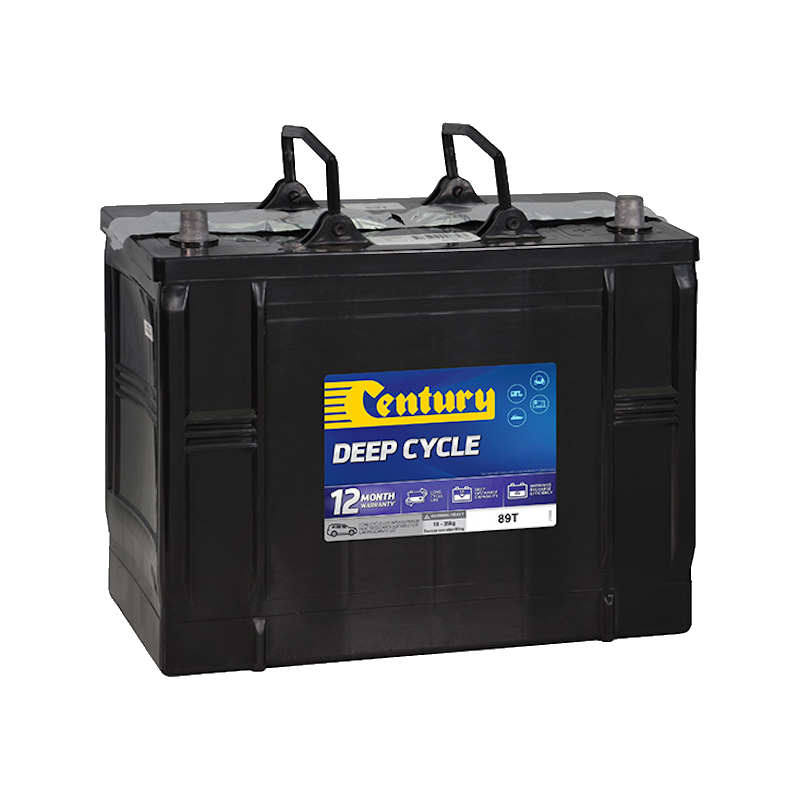
Century 89T flooded deep cycle battery, 12V 125Ah, standard SAE tapered post terminalsBattery top-view polarity diagram for a six-cell 12 volt battery with positive terminal location marked – Century batteryLine drawing of a standard tapered lead battery post, labelled Standard Terminal Post (STD) – Century battery

Century

89T Flooded Deep Cycle Battery 125Ah 12V

141116

Century 89T 125Ah 12V flooded deep cycle battery with standard SAE tapered posts, Platelock plate bracing and a maintainable antimonial construction for caravans, RV house systems, marine house banks and off-grid storage.

$540.00

4 interest-free payments of $135.00 with
or finance your build with
We accept
Universal fit for 12V house / auxiliary applications. Fits:

Shipping & collection

Worldwide shipping available*
In-store pickup
Professional installation available

*Shipping is calculated at checkout based on your location. Some products can't be delivered to every address.

A 12V 125Ah flooded deep cycle battery that runs house loads, dual battery systems and off-grid gear through long discharge cycles. Powers fridges, inverters, lights and water pumps across caravans, camper vans, battery banks and marine house setups. Fits upright-mount battery boxes and dual-battery trays with the standard SAE tapered post pattern.

Thick cast antimonial grids and glass-mat separators carry it through repeated deep discharges. Platelock internal bracing holds plates steady against vibration from corrugated-road and marine use. The container is heavy-duty polypropylene with moulded carry handles and a mud rack across the base. Dimensions are 347 by 173 by 261 mm, 282 mm with terminal height, and the battery weighs 34 kg.

Keep it upright in a vented location so hydrogen can escape during charging, and top up the electrolyte with distilled water every three to six months. Charge with a deep-cycle profile at 14.4V bulk and 13.2 to 13.5V float; absorb capacity sits at 12.5A, so size the DC-DC charger to match. Fuse the positive cable within 300 mm of the terminal with a MIDI or ANL rated above the continuous accessory load.

  • 125Ah C20 capacity:Deep reserve for running fridges, lights and water pumps across multi-day trips without a top-up charge. Flooded antimonial construction:

Electrical

Capacity (C20): 125Ah
Capacity (C10): 113Ah
Capacity (C5): 101Ah
Voltage: 12V
Float Charge: 13.2 to 13.5V
Equalisation Charge: 14.4V (at 25C)
Max Charge Current: 12.5A
Chemistry: Flooded lead-antimonial

Build

Dimensions (L x W x H): 347 x 173 x 261 mm
Total Height (with terminals): 282 mm
Weight: 34 kg
Terminal: Standard SAE tapered post
Container: Polypropylene (PP)
Separator: Polyethylene with glass mat
Grid: Cast lead-antimonial alloy
Features: Moulded carry handles, mud rack base
Length347 mm Width: 173 mm Height: 261 mm Total Height (with terminals): 282 mm Weight: 34 kg

Mount upright in a vented battery box or compartment. Hydrogen gas vents off during charging, so sealed enclosures without a breather hose risk pressure buildup over time.

Torque the standard SAE tapered posts to the clamp manufacturer's spec, typically 6 to 8 Nm. Firm enough for a solid post-to-clamp interface, light enough to not crush the post.

Fuse the positive cable within 300 mm of the terminal with a MIDI or ANL fuse rated above continuous accessory load. 100A covers a typical dual-battery setup running fridge, lights and water pump; 150A if an inverter sits on the same bus.

Charge with a deep-cycle profile at 14.4V bulk and 13.2 to 13.5V float. Maximum charge current is 12.5A, so size the DC-DC charger accordingly; a larger unit will exceed the 10% charge rate recommended for flooded antimonial chemistry and shorten service life.

Universal fit for 12V house / auxiliary applications. Fits:
Caravans and camper trailers (dual-battery trays, vented battery boxes)
RV house systems (standalone or parallel battery banks)
Marine house loads (ventilated battery compartments)
Off-grid solar and backup storage
Golf carts, mobility scooters and wheelchairs where the OEM allows a Group 24 flooded
Cranking service — this is a deep cycle, not a starter battery
24V-only systems — single 12V unit; wire two in series for 24V
Sealed, non-vented compartments — the battery vents hydrogen during charging

Q: What's the difference between flooded, AGM and GEL deep cycle batteries?
A: Flooded uses liquid electrolyte and is maintainable (top-ups extend life). AGM uses glass mats to absorb the electrolyte, so it is sealed, maintenance-free, and happy mounted at any angle. GEL immobilises electrolyte in silica paste, giving the deepest cycle depth but needing a specific GEL charge profile. Flooded wins on cost per Ah and runs longest if you top up the water every few months.

Q: What does C20 capacity mean?
A: Capacity rated when discharged over 20 hours at 25C. At 125Ah C20, this battery delivers 6.25A continuously for 20 hours before reaching the 10.5V cut-off. Pull faster and total capacity drops: C10 gives 113Ah, C5 gives 101Ah.

Q: Will this run my fridge for a weekend trip?
A: A 60L 12V compressor fridge averaging 2A draw runs about 60 hours (around 2.5 days) off a full charge before hitting the 50% depth-of-discharge recommended for cycle life. Longer trips need solar top-up or a DC-DC charger from the vehicle alternator.

Q: Can I mount this on its side?
A: No. Flooded batteries must stay upright. Tilting past about 15 degrees risks electrolyte spillage and exposes the top of the plates to air, which permanently damages capacity.

Q: What charger profile should I use?
A: A deep-cycle or flooded profile. Bulk charge at 14.4V, float at 13.2 to 13.5V, monthly equalisation at 14.4V for 12 to 24 hours when the battery is part of a bank. Maximum charge current is 12.5A.

Q: How often does the electrolyte need topping up?
A: Check every three months in normal use, monthly in hot weather or when the battery is cycled hard. Top up only with distilled water (never tap water or acid) and only after a full charge. Fill to the ring inside the cell, not above.

Q: What size fuse should I run on the positive cable?
A: Size the fuse to protect the cable, not the battery. A 70mm2 cable to a dual-battery setup takes a 150A MIDI; an 8mm2 cable to a smaller fridge-and-lights loop takes a 40A ANL. The fuse sits within 300 mm of the battery positive terminal, always.

Q: Can I use this as a starter battery?
A: No. This is a deep cycle battery, built for sustained low-current discharge. It will crank an engine once or twice in a pinch, but repeated high-current cranking shortens service life sharply. Use a dedicated starting or dual-purpose battery for engine starts.

Q: What's the warranty period and what does it cover?
A: 12 months against manufacturing defects. Normal wear from discharge cycles, electrolyte depletion from missed top-ups and damage from mis-charging are not covered. Full terms live in the warranty policy linked from the footer.

Q: How does the 89T compare to AGM alternatives like the C12-125XDA?
A: The AGM equivalent is sealed and maintenance-free, mounts at any angle, and sits around 30 percent more per Ah. The 89T flooded wins on cost and total cycle life if the install is upright and you'll do the three-monthly water top-ups. Pick AGM for a cramped install, dusty environment or set-and-forget use; pick the 89T for a vented battery box in a caravan or shed and the lower price per Ah.

Join our community.