EA-Logo-RGB-Master_Yellow-Dark-Grey-Black


Currency

Cart 0

SIGN UP FOR $10 OFF YOUR FIRST ORDER

Sorry, looks like we don't have enough of this product.

Pair with
Estimate shipping
Add order notes
Is this a gift?
Subtotal Free
View cart
Shipping, taxes, and discount codes are calculated at checkout

Your Cart is Empty

Home / Lighting / Driving & light bars
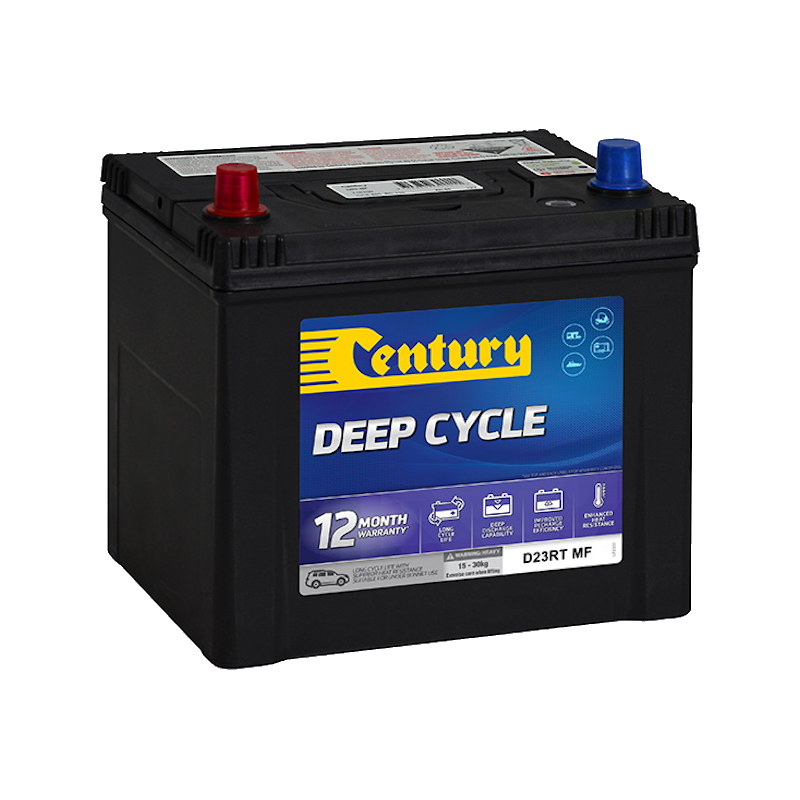
Century D23RT MF 65Ah 12V deep cycle flooded battery with carry handles and state of charge indicatorBattery top-view polarity diagram for a six-cell 12 volt battery with positive terminal location marked – Century batteryLine drawing of a standard tapered lead battery post, labelled Standard Terminal Post (STD) – Century battery

Century

D23RT MF Deep Cycle Flooded Battery — 65Ah 12V

145109

A 65Ah flooded deep cycle battery built for upright mounting in ventilated spaces. Runs fridges, water pumps, LED lighting and camp power for caravans, campers and dual-battery 4WDs between charges. Fits any D23 group tray at 230 by 171 by…

$275.00

4 interest-free payments of $68.75 with
or finance your build with
We accept
Universal fitment12V auxiliary deep-cycle battery for caravans, campers and dual-battery 4WDs

Shipping & collection

Worldwide shipping available*
In-store pickup
Professional installation available

*Shipping is calculated at checkout based on your location. Some products can't be delivered to every address.

A 65Ah flooded deep cycle battery built for upright mounting in ventilated spaces. Runs fridges, water pumps, LED lighting and camp power for caravans, campers and dual-battery 4WDs between charges. Fits any D23 group tray at 230 by 171 by 200mm with a standard tapered post terminal on the right.

Full-frame cast plates with glass mat separators handle vibration and deep discharges. Platelock internal restraints hold plates against road corrugations. Carry handles help the 17.1kg weight through hatches and under-seat spaces. A state-of-charge indicator in the top shows green when the pack is above about 70%.

Mount upright in a ventilated space and keep it off its side; flooded batteries vent hydrogen under charge and leak acid if tipped. Check electrolyte level every 3 months and top up with distilled water only. Charge with a dedicated deep-cycle profile, not a maintenance-free vehicle charger.

  • Made in Australia — built at Century Yuasa, Carole Park, Brisbane
  • 65Ah at C20 — rated capacity over a 20-hour discharge
  • Standard tapered posts — SAE automotive post, right-hand positive (D)
  • Platelock restraint — plates stay seated on corrugations
  • Full-frame cast plates — deeper discharge recovery than flat plate
  • Carry handles — moves safely through hatches and under seats
  • State-of-charge indicator — green dot shows above 70% charge

Electrical

Voltage: 12V

Capacity: 65Ah at C20

Build

Chemistry: Flooded

Terminal: STD post

Polarity: D (right +)

Case: ABS

Weight: 17.1kg
Length230mm
Width171mm
Height200mm (220mm with terminals)
Weight17.1kg

Mount upright in a ventilated compartment. Flooded batteries vent hydrogen on charge; sealed cabinets or sleeping areas are not suitable. Keep clear of fuel lines, open flames and heat sources.

Hold the battery with a top clamp or J-hook rated for its weight. Torque terminal nuts to 10 Nm on standard tapered posts. Smear a thin film of terminal grease over the clamps to resist corrosion.

Fuse the positive feed within 300mm of the terminal. Size the fuse to the cable, not the battery capacity: a MIDI 40A for 6mm² cable, 60A for 8mm², 100A for 16mm². Match the main switch rating to the fuse.

Charge with a deep-cycle profile at 14.4-14.8V bulk and 13.5-13.8V float. A smart multi-stage charger or DC-DC with a flooded setting is the right tool; a basic trickle charger or alternator-direct connection shortens the life. Check electrolyte level every 3 months and top up with distilled water only.

12V auxiliary deep-cycle battery for caravans, campers and dual-battery 4WDs
Suits 12V DC auxiliary systems
Upright mounting in ventilated compartments
Not for cranking an engine, use a starting or dual-purpose battery instead
Not for 24V systems unless paired as two 12V in series

Q: What's the difference between a flooded, AGM and GEL deep cycle battery?
Flooded batteries hold liquid electrolyte that needs upright mounting, ventilation, and periodic water top-up; they cost less and tolerate heat well. AGM uses a glass-mat separator that locks the electrolyte in place so the battery is sealed, maintenance-free, and can tolerate some tilt. GEL turns the electrolyte into a thick paste for the deepest cycle life, but needs a GEL-profile charger. For a budget auxiliary in a ventilated cabinet, flooded still wins on price per Ah.

Q: What does 65Ah at C20 actually mean?
It's the capacity when the battery is discharged evenly over 20 hours. 65Ah at C20 means it delivers about 3.25A continuously for 20 hours before dropping to the cut-off voltage. Pull current faster and the usable Ah drops; pull slower and you get a touch more.

Q: What does D polarity mean?
Look at the battery from the terminal end: D polarity has the positive post on the right. L polarity has it on the left. Match your vehicle's cable layout so leads reach the correct post without stretching.

Q: What's a standard tapered post or SAE terminal?
The classic lead-cone car battery post, slightly tapered so a clamp wedges tight. SAE J537 is the Australian/US standard. Universal cable clamps and quick-release terminals fit straight on.

Q: Can I use this to crank an engine?
No. Deep cycle plates are built for steady discharge, not the short burst a starter needs. Use a starting battery or a dual-purpose battery for cranking; keep this one as the house or auxiliary bank.

Q: Can I mount it on its side?
No. Flooded batteries must sit upright. On their side the liquid electrolyte leaks out of the vent caps and spills acid into the compartment. Use an AGM or GEL battery if you need any tilt.

Q: Does it need maintenance?
Yes. Pop the caps every 3 months, check the electrolyte level sits above the plates, and top up with distilled water (never tap water, never acid). Keep the terminals clean and greased. That's the full maintenance list.

Q: Can I charge it with my vehicle's alternator?
Not directly to the house bank. An alternator holds about 14V and won't push a deep cycle to full charge, and modern smart alternators drop below 13V on cruise. Fit a DC-DC charger with a flooded profile between the vehicle and the house battery; that gets a true bulk-absorption-float cycle on every drive.

Q: How many cycles will it do?
Flooded deep cycle batteries typically run 300-500 cycles at 50% depth of discharge with proper charging and electrolyte maintenance. Shallow discharges and consistent full recharging extend that further; chronic under-charging shortens it.

Q: Can I run two in series for 24V, or in parallel for more capacity?
Yes. Two in series gives 24V at the same 65Ah; two in parallel gives 12V at 130Ah. Use identical batteries of the same age and state of charge, with equal-length cables, and charge the bank as a unit with a charger set for the bank voltage.

Join our community.