EA-Logo-RGB-Master_Yellow-Dark-Grey-Black


Currency

Cart 0

SIGN UP FOR $10 OFF YOUR FIRST ORDER

Sorry, looks like we don't have enough of this product.

Pair with
Estimate shipping
Add order notes
Is this a gift?
Subtotal Free
View cart
Shipping, taxes, and discount codes are calculated at checkout

Your Cart is Empty

Home / Lighting / Driving & light bars
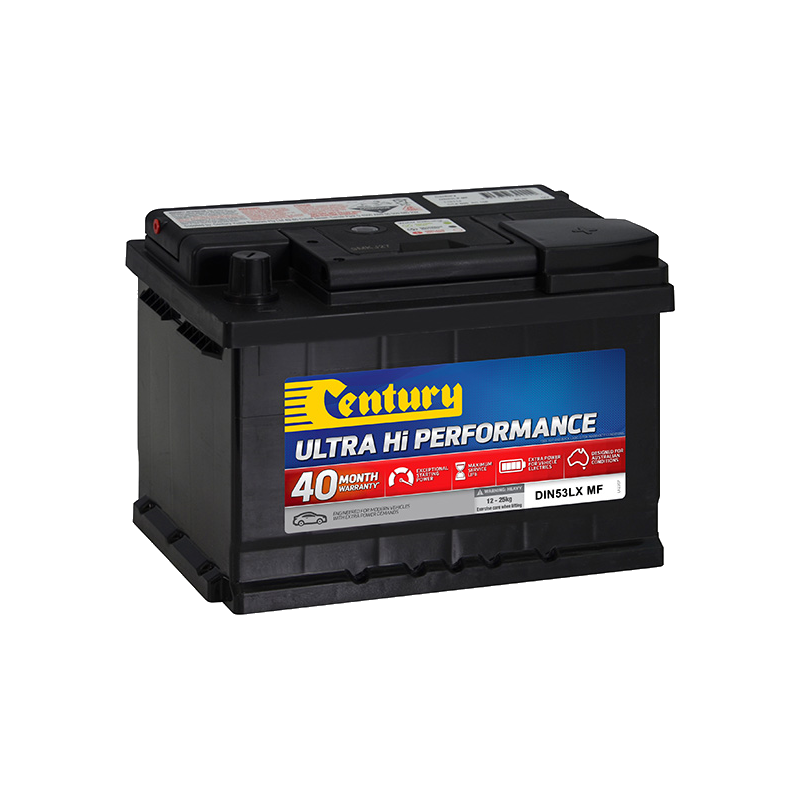

Century Hi Performance Battery DIN53LX MF 600CCA 105RC 60AHPolarity diagram of a six-cell 12 volt battery seen from above, positive terminal at the left and negative at the right, labelled 12 Volt C Polarity – Century batteryLine drawing of a standard tapered lead battery post, labelled Standard Terminal Post (STD) – Century batteryDIN53LX MF Century Hi Performance Battery 600CCA 105RC 60AH - view 4

Century

DIN53LX MF Hi Performance Battery — 12V 600CCA 60Ah

109112

Direct-fit DIN53LX maintenance-free starter battery. 12V 60Ah with 600 CCA cold cranking and 105 min reserve capacity. Calcium-plate construction with sealed central venting. Direct OE replacement for European and imported vehicles.

$260.00

4 interest-free payments of $65.00 with
or finance your build with
We accept
Direct OE replacement for 12V European and imported vehicles that specify a DIN53LX case.

Shipping & collection

Worldwide shipping available*
In-store pickup
Professional installation available

*Shipping is calculated at checkout based on your location. Some products can't be delivered to every address.

A direct-fit DIN53LX maintenance-free starter battery that cranks European and imported vehicles with 600 CCA at 12V and holds 105 minutes of reserve for key-off accessories. Drops into vehicles OE-specified for the DIN53LX case: Audi A3 and A4 petrol, VW Golf, Polo and Passat, Skoda Octavia, BMW 1-series and 3-series petrol, Mercedes A and B class, Hyundai i30 and i40, Mazda 3 and Mazda 6, Ford Focus and Mondeo.

The case is 242 by 175 by 175 mm, 14.4 kg, with C polarity (negative post on the LEFT when the terminals face you) and standard tapered STD posts. Calcium plate alloy on both grids pulls self-discharge down to around 2 percent per month at 20 degrees celsius and keeps watering intervals out of normal service. Central venting with a flame arrestor sits under the top cover, and a state-of-charge indicator eye sits above the lid for quick visual checks.

What sets it apart

Century develops and tests the Hi Performance range for Australian summer heat, dusty engine bays and heavy OE accessory loads. Calcium construction and the vibration-resistant plate design hold up through long-run touring and taxi service, and the DIN form factor hits the exact OE spec that European marques and current imports call for without any tray adaption.

Charging, mounting and fusing

Charger profile is standard flooded calcium wet-cell: 14.4 to 14.7 V bulk and 13.5 to 13.8 V float at 20 degrees celsius, with temperature compensation if the alternator or external charger provides it. Clamp the battery to the OE tray using the vehicle's existing top clamp or J-hook before closing terminals. Torque posts to 10 to 12 Nm. Fuse the starter cable and main vehicle loom at the OE spec, not at the battery post itself. Not a cranking battery substitute for Start-Stop vehicles, which need an EFB or AGM battery from Century's ISS Active range.

  • 600 CCA — Cold cranking for European starters
  • 105 min reserve — Key-off accessory runtime
  • 60Ah capacity — Deep draw tolerance
  • Calcium plates — Low self-discharge, long shelf life
  • Maintenance-free — Sealed vent, no watering
  • STD terminal posts — Direct OE connection
  • DIN53LX case — 242 by 175 by 175 mm

Electrical

Voltage: 12V DC

CCA: 600 A

Reserve capacity: 105 min at 25 A

Capacity: 60Ah C20

Technology: Calcium wet-cell

Build

Terminal: STD, C polarity

Case: DIN53LX

Vent: Central, flame arrestor
Length242 mm
Width175 mm
Height175 mm
Weight14.4 kg

Install the battery with the vehicle ignition off and all accessories disconnected. On modern European and import vehicles with battery management modules, a battery registration or BMS reset via the dealer scan tool may be required after fitment; check the vehicle service manual.

Clamp the battery to the OE tray using the vehicle's existing top clamp or J-hook. Clean the terminal posts and clamps before connection. Connect positive first, then negative. Torque terminal posts to 10 to 12 Nm. Do not over-tighten.

Charger profile is standard flooded calcium wet-cell. Bulk 14.4 to 14.7 V, float 13.5 to 13.8 V at 20 degrees celsius, with temperature compensation if the charger supports it. Do not use lithium or AGM-only charger profiles.

Fuse the starter cable and main vehicle loom at the OE spec, not at the battery post itself. For any auxiliary system added in-car, fuse at the source according to the cable gauge.

Direct OE replacement for 12V European and imported vehicles that specify a DIN53LX case.
12V vehicle systems with standard electronics
European marques (VW, Audi, Skoda, BMW, Mercedes-Benz) specifying DIN53LX
Japanese and Korean imports specifying DIN53LX (Hyundai i30, Mazda 3, etc.)
24V single-battery systems
Start-Stop vehicles requiring EFB or AGM (use Century ISS Active range)

Q: What does DIN53LX actually mean?
The DIN code is a European standard that fixes the battery case dimensions and terminal layout. A DIN53LX measures 242 by 175 by 175 mm with STD tapered posts and C polarity, so it drops into the OE tray and clamps of any vehicle that originally specified a DIN53LX unit.

Q: What does maintenance-free (MF) mean?
MF means sealed-vent construction with a calcium plate alloy that cuts water loss to near zero across normal service. There are no filler caps to open and no electrolyte top-ups; the battery stays sealed until the end of its service life.

Q: What does CCA mean?
Cold Cranking Amps is the current the battery delivers for 30 seconds at minus 18 degrees celsius while holding at least 7.2 V across its terminals. 600 CCA is on the mid-higher side for a 60Ah passenger-car battery and comfortably over OE spec for most DIN53LX-fit vehicles.

Q: What's reserve capacity?
Reserve capacity (RC) is the minutes the battery runs a continuous 25 A load at 25 degrees celsius before terminal voltage drops below 10.5 V. 105 minutes gives roughly 44Ah of key-off runtime for hazards, parkers, interior lights or a parked-up accessory draw.

Q: Does polarity matter?
Yes. This battery is C polarity: with the terminals facing you, the negative post sits on the LEFT and the positive on the RIGHT. The OE wiring loom reaches the battery at a fixed length, so a wrong-polarity battery means the cables don't reach the correct posts, and swapping them risks shorting the main cable against the chassis.

Q: What vehicles does it fit?
Any 12V vehicle that OE-specifies a DIN53LX case. Common fits: Audi A3 and A4 petrol models, VW Golf, Polo and Passat, Skoda Octavia, BMW 1-series and 3-series petrol, Mercedes A and B class, Hyundai i30 and i40, Mazda 3 and Mazda 6, Ford Focus and Mondeo. Check the vehicle owner's manual or the Century Battery Finder for your specific VIN.

Q: Can I use it in a Start-Stop vehicle?
No. Start-Stop vehicles cycle the battery heavily under partial state of charge, which standard flooded calcium batteries aren't built for. Use an EFB or AGM battery from Century's ISS Active range in a Start-Stop vehicle.

Q: Can I use it in a 24V system?
No. This is a single 12V unit. 24V vehicle systems normally use two 12V batteries wired in series, each rated for the application; this is a 12V passenger-car battery and isn't matched to that duty.

Q: Can I install this myself?
For older OE-simple vehicles, yes: disconnect negative first, swap, reconnect positive first, torque posts to 10 to 12 Nm. For modern European marques and current imports with battery management modules, the vehicle may require a battery registration or BMS reset via the dealer scan tool. If unsure, check the owner's manual or book in with us.

Q: What charger profile does it need?
Standard flooded calcium wet-cell profile: 14.4 to 14.7 V bulk and 13.5 to 13.8 V float at 20 degrees celsius with temperature compensation if the charger supports it. Do not use lithium or AGM-only charger profiles; the voltage ceiling will drive the battery past safe gassing limits.

Join our community.