EA-Logo-RGB-Master_Yellow-Dark-Grey-Black


Currency

Cart 0

SIGN UP FOR $10 OFF YOUR FIRST ORDER

Sorry, looks like we don't have enough of this product.

Pair with
Estimate shipping
Add order notes
Is this a gift?
Subtotal Free
View cart
Shipping, taxes, and discount codes are calculated at checkout

Your Cart is Empty

Home / Lighting / Driving & light bars
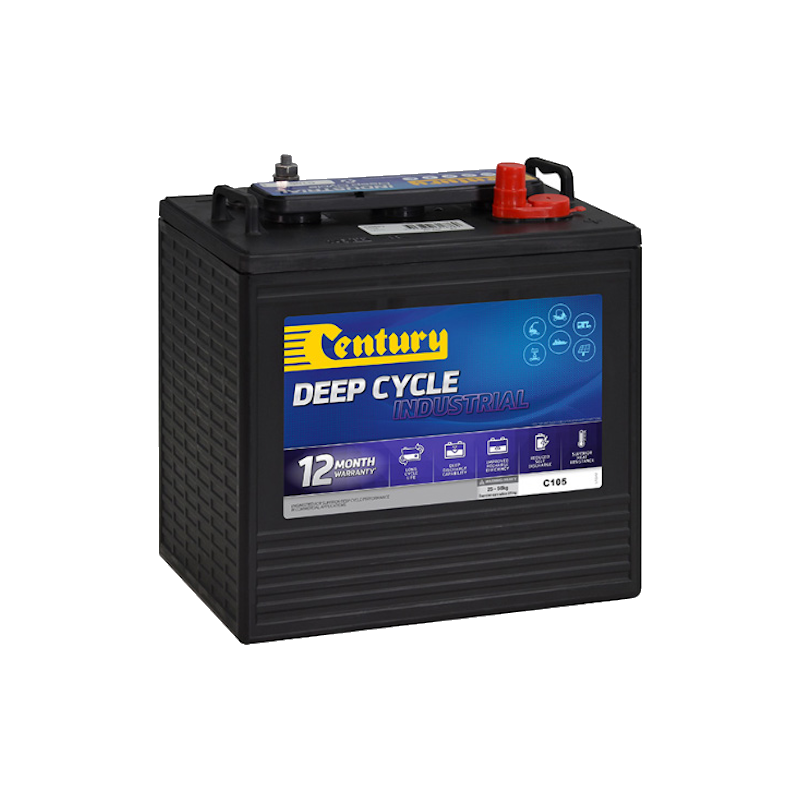
Century C105 Industrial Deep Cycle Battery, 6V 225Ah, flooded lead-acid with wingnut terminals in GC2 golf-cart group sizePolarity diagram of a three-cell 6 volt battery seen from above, negative terminal at the top left and positive at the bottom right, labelled 6 Volt – A Polarity – Century industrial deep cycle batteryLine drawing of a battery terminal with a threaded post and wing nut on a raised base, labelled W/Nut – Century industrial deep cycle battery

Century

C105 Industrial Deep Cycle Battery — 6V 225Ah

141111

A 6V 225Ah flooded deep cycle battery with wingnut terminals and GC2 group size, built to pair in series for 12V, 24V, 36V or 48V house banks on golf carts, industrial equipment and off-grid solar.

$410.00

4 interest-free payments of $102.50 with
or finance your build with
We accept
Universal fitment6V deep cycle battery

Shipping & collection

Worldwide shipping available*
In-store pickup
Professional installation available

*Shipping is calculated at checkout based on your location. Some products can't be delivered to every address.

A 6V flooded deep cycle battery that puts 225 amp-hours into golf carts, floor scrubbers, scissor lifts, mobility scooters and off-grid solar banks wired in series for 12V, 24V, 36V or 48V. Fits the GC2 group size slot used across Trojan T105 and most industrial 6V applications. Runs house loads, auxiliary accessories, lighting and water pumps between recharges.

The case is heat-sealed polypropylene with thicker cast plates for deep discharge and recharge. Wingnut terminals take ring lugs under the thumb-tightened nut for straightforward loom connection. Reserve capacity reads 225 minutes at 75A or 447 minutes at 25A, measured at the 20-hour rate. Weighs 28.6 kg wet and sits 264 by 181mm on the floor at 245mm tall, or 276mm counting the terminal posts.

Mount upright with ventilation above the vent caps and keep electrolyte above the plates with distilled water top-ups every three months or after heavy cycling. Not for cranking duty, the thicker deep-cycle plates don't deliver the short-burst current an engine starter needs.

  • 225Ah at C20 — delivers 225 amp-hours measured at the 20-hour rate
  • 6V nominal — pair in series for 12V, 24V, 36V or 48V banks
  • 447 min at 25A — holds house loads through long overnight draws
  • Wingnut terminals — ring-lug friendly, no spanner needed
  • GC2 group size — drop-in slot for Trojan T105 and most industrial 6V banks
  • Full-frame cast plates — thicker plates handle repeated deep discharge
  • Heat-sealed polypropylene — shock-resistant case built for vibration

Electrical

Voltage: 6V DC

Capacity (C20): 225Ah

Reserve at 25A: 447 min

Reserve at 75A: 225 min

Max charge: 29.3A

Chemistry: Flooded FLA

Build

Terminal: W/Nut post

Group size: GC2

Case: Polypropylene

Vents: Non-sealed
Length: 264mm

Width: 181mm

Height to top of case: 245mm

Height to top of terminals: 276mm

Weight (wet): 28.6kg

Mount upright on a flat, ventilated surface. The vent caps release small amounts of hydrogen during charging, so install in a battery box with top venting or an open compartment. Keep terminals clear of overhead metalwork.

Fit ring lugs sized to the wingnut terminal post and tighten the nut hand-firm, then back it off a quarter turn to seat the lug, around 10 Nm equivalent. Smear petroleum jelly or terminal grease over the finished connection to slow oxidation.

Size the positive cable to the maximum continuous current the bank will see and fuse the positive feed within 300mm of the terminal. A 100A MIDI, MEGA or ANL fuse covers most golf-cart and small off-grid service feeds; step up for larger inverter banks.

Charge with a flooded-profile charger set to a bulk current of up to 29.3A and bulk voltage of 7.14 to 7.29V per cell (14.3 to 14.6V on a 12V string, 28.6 to 29.2V on 24V, 42.8 to 43.7V on 36V, 57.1 to 58.3V on 48V). Equalise monthly at 7.5 to 8.1V per cell for one to three hours. Top up electrolyte every three months or after heavy cycling with distilled water only.

6V deep cycle battery
Pairs in series for 12V (two cells), 24V (four), 36V (six) or 48V (eight) banks
Suits golf carts, scissor lifts, floor scrubbers, mobility scooters, off-grid solar
Not for cranking an engine, the deep-cycle plates can't deliver starting current
Not for 12V single-battery use, this is a 6V cell

Q: What does deep cycle actually mean?
Deep cycle means the battery is built to be discharged to a low state of charge and recharged repeatedly without damage. Starter batteries deliver a short, high burst of current to crank an engine; deep cycle batteries deliver a steady lower current over hours and hold up to being drained and refilled over and over. The C105 is deep cycle only, not a starter.

Q: What does the C20 rate mean?
C20 is the industry convention for stating deep-cycle capacity. 225Ah at C20 means the battery will deliver 11.25A continuously for 20 hours before dropping to the end-of-discharge voltage. Draw more current and effective capacity drops; draw less and it stays close to the published figure.

Q: What is reserve capacity?
Reserve capacity is minutes to end-of-discharge at a fixed load, usually 25A for leisure batteries. The C105 holds 447 minutes at 25A, or 225 minutes at a heavier 75A draw. It tells you how long the battery runs a known accessory load before it needs recharging.

Q: Why 6V instead of 12V?
Six-volt deep cycle cells use thicker plates for their footprint, so paired in series they usually outlast two 12V deep cycle batteries of the same combined Ah. Golf carts, scissor lifts and off-grid solar banks have used 6V-in-series layouts for decades for that cycle-life reason. The Trojan T105 made the format famous and the C105 is the direct Century equivalent.

Q: How do I wire two in series for 12V?
Pair the positive of one battery to the negative of the next with a short link cable sized to the full load current. The remaining positive on battery two is now the 12V bank positive and the remaining negative on battery one is the bank negative. Four in series makes 24V, six makes 36V, eight makes 48V.

Q: What are W/Nut terminals?
W/Nut (wingnut) terminals are threaded studs with a thumb-tightened wingnut on top. Ring lugs drop over the stud and the wingnut clamps them down without a spanner. Common on industrial and golf-cart batteries because they take re-tightening in the field.

Q: What is GC2 group size?
GC2 is the Battery Council International group size standard for a 10.3 by 7.1 by 10.9 inch 6V golf-cart battery. The C105, Trojan T105, Crown CR-220 and most 6V 220 to 230Ah deep-cycle batteries share this footprint so they drop into the same tray or cradle.

Q: What charger profile does it need?
A flooded (FLA) profile with bulk current up to 29.3A and bulk voltage of 7.14 to 7.29V per cell. Multiply by the number of cells in series: 14.3 to 14.6V for 12V banks, 28.6 to 29.2V for 24V, 42.8 to 43.7V for 36V, 57.1 to 58.3V for 48V. Equalise monthly at 7.5 to 8.1V per cell for one to three hours.

Q: How often does the electrolyte need topping up?
Check every three months in normal service, more often after heavy cycling or in hot weather. Top up with distilled water only, keeping the level above the plates but below the fill marker. Never add acid, and never top up before charging, always after.

Q: Can I use this to crank an engine?
No. Deep cycle plates are built thicker to survive repeated discharge, which means they can't deliver the short burst of several hundred amps that an engine starter demands. Use a starter or dual-purpose battery for engine cranking, and keep the C105 for house loads.

Join our community.