EA-Logo-RGB-Master_Yellow-Dark-Grey-Black


Currency

Cart 0

SIGN UP FOR $10 OFF YOUR FIRST ORDER

Sorry, looks like we don't have enough of this product.

Pair with
Estimate shipping
Add order notes
Is this a gift?
Subtotal Free
View cart
Shipping, taxes, and discount codes are calculated at checkout

Your Cart is Empty

Home / Lighting / Driving & light bars
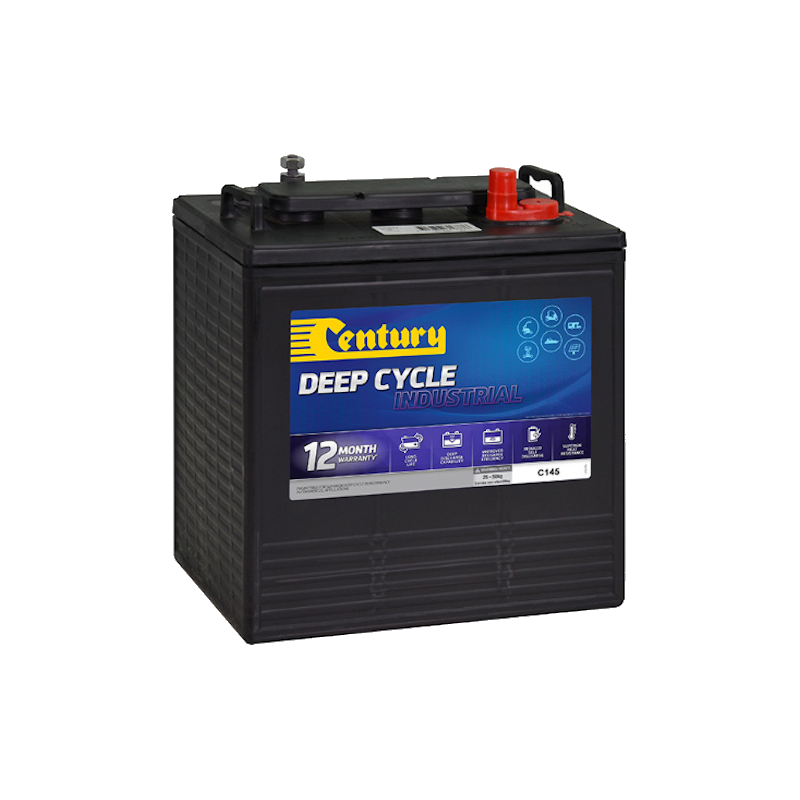
Century C145 industrial deep cycle battery, 6V 260 amp-hours, wingnut terminals, flooded lead-acid in black ABS case.Polarity diagram of a three-cell 6 volt battery seen from above, negative terminal at the top left and positive at the bottom right, labelled 6 Volt – A Polarity – Century industrial deep cycle batteryLine drawing of a battery terminal with a threaded post and wing nut on a raised base, labelled W/Nut – Century industrial deep cycle battery

Century

C145 — 6V 260Ah Industrial Deep Cycle Battery

141112

Industrial 6V 260Ah flooded deep cycle battery with wingnut terminals. Suits golf carts, mobility scooters, scissor lifts and off-grid 12V/24V/36V/48V house banks.

$505.00

4 interest-free payments of $126.25 with
or finance your build with
We accept
Universal fitment6V 260Ah flooded deep cycle for industrial equipment and series house banks

Shipping & collection

Worldwide shipping available*
In-store pickup
Professional installation available

*Shipping is calculated at checkout based on your location. Some products can't be delivered to every address.

A flooded 6V deep cycle battery that puts 260 amp-hours into golf carts, mobility scooters, scissor lifts, aerial platforms and off-grid solar banks wired in series for 12V, 24V, 36V or 48V. Runs the drive motor on a golf cart or scrubber all shift and still has the depth to recover overnight on a standard golf-cart charger. Fits any 6V battery tray that takes a 264 by 181 by 295mm case and 40kg of weight.

Built with full-frame cast plates and heavy-duty internal connections to handle repeated deep discharge and recharge cycles without losing capacity. Terminals are wingnut (W/NUT) posts on top of the case for straight-in ring-lug connection without a spanner. The ABS case is heat-sealed and shock-resistant, with flip-up vent caps per cell for distilled-water top-up.

Charge off a 6V bulk, absorption and float cycle charger set to 7.4V absorption and 6.75V float at 25 degrees C, or wire two in series and charge the string off a 12V deep cycle charger set to 14.8V absorption and 13.5V float. Keep electrolyte topped up every three months with distilled water. Not for engine cranking, and don't install inside a sealed cabinet without ventilation to vent hydrogen during charge.

  • 260Ah at C20 — long runtime for industrial equipment
  • 6V nominal — pairs in series for 12V, 24V, 36V or 48V
  • Wingnut terminals — ring-lug fit without a spanner
  • Full-frame cast plates — survives repeated deep discharge
  • Heavy-duty connections — low internal resistance under load
  • Shock-resistant ABS case — rated for industrial vibration
  • Vented flooded chemistry — maintainable with distilled water

Electrical

Voltage: 6V DC

Capacity: 260Ah (C20)

Chemistry: Flooded

Polarity: A (+ right)

Max charge: 26A C10

Build

Case: ABS heat-sealed

Terminal: W/NUT post

Vents: 3 flip-caps
Length: 264mm

Width: 181mm

Case height: 264mm

Total height with terminals: 295mm

Weight: 39.9kg

Mount upright on a flat vented surface rated for 40kg per battery, with 25mm clearance above the terminals for vent-cap access. Secure with a strap or hold-down bar; the case is shock-resistant but repeated vibration without restraint will loosen internal connections over time.

Attach cable ring lugs under the wingnut and tighten by hand until firm. Don't use a spanner; stripping the threaded post is a warranty exclusion and the post can't be replaced in the field.

Fuse the positive output within 300mm of the terminal. A MIDI 60A fuse suits a modest industrial accessory load; a MEGA 150A to 250A fuse suits inverter and heavy drive-motor loads. Match the fuse to the cable's current rating, not just the battery's capacity.

Charge with a 6V bulk, absorption and float charger at 7.4V absorption and 6.75V float, or wire the batteries in series and use a charger set for the full string voltage (14.8V for a 12V pair, 59.2V for a 48V string of eight). Top up electrolyte every three months with distilled water.

6V 260Ah flooded deep cycle for industrial equipment and series house banks
Golf carts, mobility scooters, scissor lifts, aerial lifts, floor scrubbers
Off-grid solar banks wired in series for 12V, 24V, 36V or 48V
Not for engine cranking: plate structure is wrong for the amperage pulse
Not for sealed enclosures without ventilation: vents hydrogen during charge

Q: What does deep cycle mean?
A: Deep cycle batteries are built to be discharged down to 20 to 30 percent of capacity and recharged, repeatedly, across hundreds of cycles. Starter batteries deliver a short high-amperage pulse once and recharge off the alternator; deep cycle batteries deliver steady moderate current for hours. Different plate structure, same lead-acid chemistry.

Q: What does 260Ah at C20 mean?
A: C20 is the discharge rate the capacity figure is measured at. 260 amp-hours delivered at a steady draw of 13 amps over 20 hours. Draw harder and total delivered capacity drops because of internal resistance; draw lighter and it stays close to the rated figure.

Q: What is the reserve capacity?
A: Century doesn't publish reserve capacity for the Industrial 6V range. Industry reference for a 260Ah flooded 6V battery is roughly 450 to 600 minutes at a 25A draw. Treat the Ah at C20 figure as the primary spec and the practical runtime for most industrial equipment.

Q: Why 6V instead of 12V?
A: Golf carts, scissor lifts and industrial scrubbers are designed around 36V or 48V drive systems built from strings of 6V batteries. A 6V 260Ah pair wired in series gives 12V 260Ah; a 48V string of eight 6V 260Ah batteries gives 48V at 260Ah. The 6V format also lets you add more capacity to a 12V or 24V house bank by stacking strings in parallel.

Q: How do I wire two in series for 12V?
A: Positive of battery A connects to negative of battery B with a short heavy cable (35mm² or 2 AWG for most loads). The remaining positive on battery B is the 12V positive output; the remaining negative on battery A is the 12V negative. Charge the pair with a 12V charger set for the string's full voltage, not two separate 6V chargers at the same time.

Q: Can I use this to start an engine?
A: No. The plate structure is wrong for cranking amperage. Try to crank an engine on this battery and the plates will warp or short internally. Starter batteries are a separate product class with thin high-surface-area plates for brief hundreds-of-amps pulses. Deep cycle batteries push moderate steady current for hours.

Q: What charger profile does a 6V flooded take?
A: Bulk, absorption and float at 7.4V absorption and 6.75V float at 25 degrees C for a single 6V battery. For a 12V string (two in series), the charger profile is standard 14.8V absorption and 13.5V float. For a 48V string (eight in series), 59.2V absorption and 54V float. Charge current up to 26A per battery (10 percent of capacity) is comfortable.

Q: How often do I top up the electrolyte?
A: Check the level every three months and top up with distilled water (not tap water) until the plates are just covered. Flooded batteries lose water through electrolysis during charging. A hard-worked bank in a hot environment can need top-up every month; a lightly-worked bank once a year. Never add acid; always distilled water.

Q: What polarity is A and does it match my cables?
A: A polarity means the positive terminal is on the right when the battery is viewed from the terminal end with the vent caps facing up. Golf carts and scissor lifts built around the Trojan T145 or equivalent 6V 260Ah batteries use the same A-polarity layout, so the stock cable loom will reach without rework. Measure before swapping if your equipment uses a non-standard layout.

Q: How long will the battery last?
A: Century doesn't publish a cycle-life figure. Industry reference for a flooded 6V 260Ah industrial battery is 500 to 1200 cycles at 50 percent depth-of-discharge, depending on charge regime, temperature, and electrolyte maintenance. Daily deep cycles on a well-managed charger will see 3 to 5 years; occasional cycles with weekend-only use will see longer.

Join our community.