EA-Logo-RGB-Master_Yellow-Dark-Grey-Black


Currency

Cart 0

SIGN UP FOR $10 OFF YOUR FIRST ORDER

Sorry, looks like we don't have enough of this product.

Pair with
Estimate shipping
Add order notes
Is this a gift?
Subtotal Free
View cart
Shipping, taxes, and discount codes are calculated at checkout

Your Cart is Empty

Home / Lighting / Driving & light bars
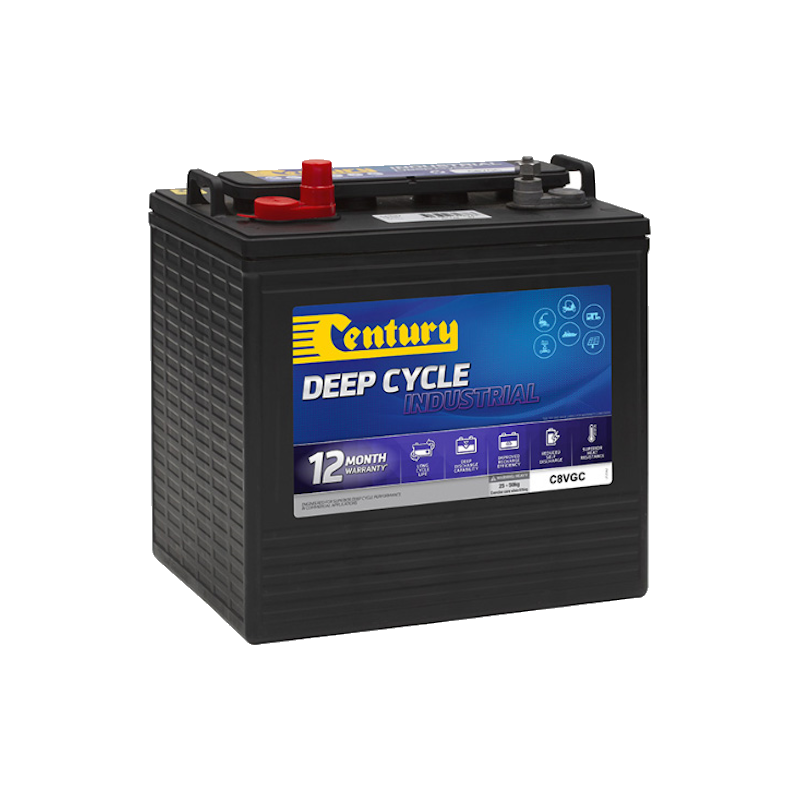
Century C8VGC 8V 170Ah flooded deep cycle battery with wingnut terminals for golf carts and industrial use

Century

C8VGC — 8V 170Ah Industrial Deep Cycle Battery

141113

8V 170Ah flooded deep cycle battery for golf carts, scissor lifts, floor scrubbers and 24V or 48V house banks. Wingnut terminals, 295 min reserve at 25A, 12-month Century warranty.

$490.00

4 interest-free payments of $122.50 with
or finance your build with
We accept
Universal fitment8V flooded deep cycle battery for industrial, mobility and series-wired house banks

Shipping & collection

Worldwide shipping available*
In-store pickup
Professional installation available

*Shipping is calculated at checkout based on your location. Some products can't be delivered to every address.

An 8V flooded deep cycle battery that puts 170 amp-hours into golf carts, floor scrubbers, scissor lifts and 24V or 48V house banks wired in series. Delivers 295 minutes of reserve capacity at 25 amps for sustained draw. Fits industrial equipment, personal mobility vehicles and larger off-grid solar banks running on 8V-string architecture.

Flooded lead-acid construction with thicker cast plates and heavy-duty internal connections built for repeat deep discharge and recharge. The polypropylene case is heat-sealed and vibration-resistant for mobile and industrial duty. Terminals are wingnut style for straight bolt-up to industrial wiring looms, and the case measures 264 by 181 by 245 mm (276 mm overall with terminals) at 29 kg wet.

Mount upright only; this is a vented flooded cell that can spill if tipped. Top up with distilled water every three to six months depending on duty cycle, and keep bulk charge current between 17 and 22 amps to protect plate life.

  • 170Ah at C20 — 20-hour deep-cycle capacity
  • 8V nominal — pair 3× for 24V, 6× for 48V
  • 295 min RC at 25A — sustained reserve for cleaners and lifts
  • Wingnut terminals — direct bolt-up to industrial looms
  • Thicker cast plates — repeat deep-discharge resilience
  • Heat-sealed polypropylene — vibration resistant for mobile duty
  • Flooded chemistry — maintainable with distilled water top-ups

Electrical

Voltage: 8V DC

Capacity (C20): 170Ah

Reserve capacity: 295 min at 25A

Max charge current: 17–22A bulk

Charge temp: 0 to 50°C

Discharge temp: -18 to 50°C

Build

Chemistry: Flooded lead-acid

Case: Polypropylene

Terminal: Wingnut (W/NUT)

Vibration resistant: Yes
Length264 mm
Width181 mm
Height245 mm
Overall height (with terminals)276 mm
Weight (wet)29 kg

Mount upright on a flat surface with 10 mm clearance all round for ventilation. Wingnut terminals accept M8 ring lugs; tighten to around 10 Nm so the connection stays solid without crushing the lead post.

Fuse the positive feed close to the battery, sized to the cable rather than the load. A 150A MEGA or 170A MIDI suits most 25mm² to 35mm² house-bank runs. Oversize the cable before oversizing the fuse.

Use a flooded-profile charger that lets you set the per-string voltage: around 9.6 to 9.9V bulk per 8V battery (14.4–14.7V in a 24V 3-string), tapering to about 9.0V float. If you are wiring 3× in series for 24V, select the 24V flooded profile on the charger.

Top up with distilled water every three to six months depending on duty cycle. Check specific gravity annually if you want to track cell health.

8V flooded deep cycle battery for industrial, mobility and series-wired house banks
Golf carts, floor scrubbers, scissor lifts, aerial lifts, personal mobility vehicles, large solar banks
24V (3× in series) and 48V (6× in series) systems
Not for cranking vehicles — this is a deep-cycle battery with no CCA rating
Not for 12V single-battery setups — this is an 8V-only cell meant to be paired

Q: What does 'deep cycle' actually mean?
A: A deep cycle battery is built to be drained to 50% or lower, then recharged, hundreds of times without damaging the plates. A starter battery dies after a dozen deep draws. Deep cycle plates are thicker and the lead alloy is cast for the long slow discharge a golf cart or floor scrubber draws over a shift.

Q: What does Ah at C20 actually mean?
A: 170Ah at C20 means the battery delivers 8.5 amps for 20 hours before it is discharged. Draw it harder and you get less total energy; draw it slower and you get a touch more. C20 is the industry-standard rating for deep cycle lead-acid.

Q: What is reserve capacity (RC)?
A: Reserve capacity is how many minutes the battery holds up at a fixed discharge current before the voltage drops below the usable floor. The C8VGC gives 295 minutes at 25 amps and 75 minutes at 75 amps, so a floor scrubber pulling 25A has nearly five hours of run time per 8V battery in a 24V string.

Q: Can I use this to crank a car or 4WD?
A: No. This is a deep cycle battery with no cold cranking amp rating. A starter needs 300–700A for a few seconds; deep cycle plates are the wrong design for that burst, and the cell is 8V so it will not spin a 12V starter solenoid at all.

Q: How do I wire these for 24V or 48V?
A: Wire three in series for 24V or six in series for 48V. Connect positive of one to negative of the next with properly sized interconnects (25mm² at a minimum for a 24V golf cart), and keep each battery the same age and state of charge so no cell gets dragged down by its neighbours.

Q: What is a wingnut terminal?
A: A wingnut terminal is a threaded post with a hand-tightenable nut, built for industrial equipment where cables are swapped often. Slip an M8 ring lug over the post, drop the wingnut on, tighten by hand or with a spanner to around 10 Nm. No specialised crimper or stud required.

Q: Does this replace a Trojan T875?
A: Yes, the C8VGC is the same industry-standard 8V 170Ah golf cart format as the Trojan T875, US 8VGC and Enduroline T875. Dimensions, terminal position and voltage match, so it drops into the same tray and cable runs.

Q: How often do I need to top up the water?
A: Every three to six months with distilled water, more often in heavy duty cycles or hot climates. Keep the electrolyte above the plates and 10 mm below the fill vent. Never use tap water; the minerals shorten plate life.

Q: Can I mount this on its side?
A: No, it must be upright. This is a flooded cell with liquid electrolyte that will spill through the vent caps if tipped past about 10°. For side-mount or any-orientation installs you need an AGM or GEL deep cycle instead.

Q: What charger profile should I use?
A: Use a flooded deep cycle profile. In a 24V string bulk sits around 28.8–29.4V (9.6–9.8V per 8V battery), absorption holds there, and float drops to about 27V (9.0V each). Charge current should stay inside the 17–22A bulk range the Century datasheet specifies.

Join our community.