EA-Logo-RGB-Master_Yellow-Dark-Grey-Black


Currency

Cart 0

SIGN UP FOR $10 OFF YOUR FIRST ORDER

Sorry, looks like we don't have enough of this product.

Pair with
Estimate shipping
Add order notes
Is this a gift?
Subtotal Free
View cart
Shipping, taxes, and discount codes are calculated at checkout

Your Cart is Empty

Home / Lighting / Driving & light bars
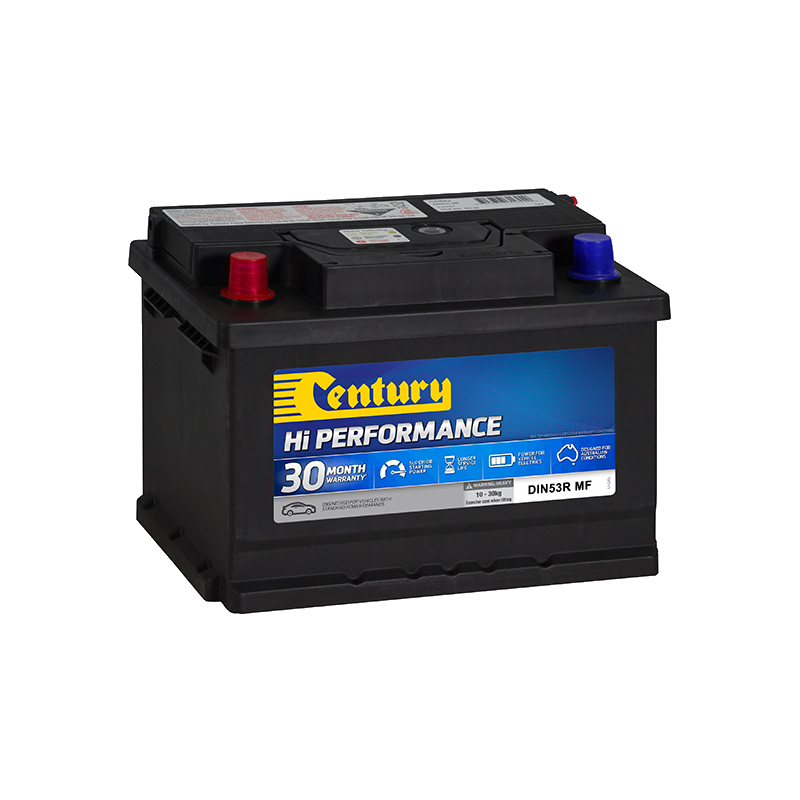
Century DIN53R MF Hi Performance maintenance-free car battery, 12V 54Ah 500 CCA with STD tapered posts and D polarity (positive right), product shotLine drawing of a standard tapered lead battery post, labelled Standard Terminal Post (STD) – Century batteryBattery top-view polarity diagram for a six-cell 12 volt battery, positive terminal at the right side, labelled 12 Volt D polarity – Century battery

Century

DIN53R MF Hi Performance Battery — 12V 500CCA 54Ah

115133

Century DIN53R MF 12V 54Ah 500 CCA calcium wet-cell starter battery. D polarity (positive right) with STD tapered posts, 242×175×175 mm case, 30-month Century Hi Performance warranty. Sized for small European marques and other DIN53R OE tray fits.

$235.00

4 interest-free payments of $58.75 with
or finance your build with
We accept
DIN53R OE tray fitment12V 500 CCA petrol and small-diesel starter battery for small European marques

Shipping & collection

Worldwide shipping available*
In-store pickup
Professional installation available

*Shipping is calculated at checkout based on your location. Some products can't be delivered to every address.

A 12V 54Ah starter battery sized for small European marques and other mid-car fitments that need a DIN53R case with the positive post on the right. Delivers 500 cold cranking amps and 90 minutes reserve for petrol and small-diesel starts in Volkswagen Polo, Audi A1, Mini, Mercedes-Benz A-Class entry petrol, BMW 1 Series base and other D-polarity European tray fits. For the mirror-polarity (C polarity, positive left) sibling used in Toyota, Mazda and Hyundai saloons, use the [handle:century-hi-performance-battery-din53l-mf-500cca-90rc-54ah] instead.

The case is 242 by 175 by 175 mm and weighs 13.5 kg. Polarity is D with the positive terminal on the right and the negative on the left when the posts face you, and the terminals are STD tapered lead posts sized for the OE top-clamp or J-hook fitted to the vehicle. Calcium plates on both sides hold self-discharge down to around 2 per cent per month at 20°C so the battery sits well on a dealer floor or in a seldom-driven weekender. Central vent with flame arrestor, recessed posts for cover clearance and a state-of-charge indicator eye round out the Hi Performance DIN build.

Hi Performance DIN is a flooded calcium wet-cell starter battery, not AGM, not EFB and not a dual-purpose deep-cycle. Do not fit it to a Start-Stop vehicle that specifies EFB or AGM, do not run it as the house battery on a caravan or camper and keep house-side cycling loads on a dedicated auxiliary. Pair two in series only for a 24V system when both batteries are the same age and matched for state of charge.

What sets it apart

Century develops and tests the Hi Performance DIN range at an Australian climatic chamber so starting performance holds up across the national climate band from Perth summers to Tasmanian winters. Reinforced plate welds and double-insulated separators cut vibration failures on corrugated tracks and dirt roads. The DIN53R OE case matches small-European tray and clamp hardware without the shim-and-pack workarounds a non-DIN substitute would need.

Charging, mounting and fusing

Charge on a flooded calcium wet-cell profile at 14.4 to 14.7 V bulk and 13.5 to 13.8 V float measured at the terminals at 20°C, with temperature compensation enabled on the charger. Modern European marques from roughly 2008 onward need a battery registration or BMS reset after replacement, done with VCDS or ODIS on Volkswagen and Audi, ISTA on BMW, Xentry on Mercedes-Benz or an equivalent dealer-scan tool, so the vehicle's energy manager relearns the fresh battery and sets the correct charging voltage. Mount in the OE tray with the factory top clamp or J-hook, torque M6 posts to 5 to 7 Nm and M8 posts to 8 to 10 Nm, and fuse the starter cable at the vehicle loom or starter end rather than at the battery post. For 24V series pairing match the two batteries by age and state of charge, run matched cable gauge between the pair and fuse the circuit at the start of the run.

  • 500 CCA — reliable petrol and small-diesel starts
  • 90 min reserve — holds accessories if the alternator drops
  • 54 Ah capacity — sized for small European OE loads
  • Calcium plates — low self-discharge during slow turnover
  • Maintenance-free — sealed cells, no top-ups required
  • STD tapered posts — direct fit for OE top clamps
  • Vibration-resistant — reinforced welds and insulated separators
  • Central vent, flame arrestor — safe venting and gas suppression

Electrical

Voltage: 12V DC

CCA: 500 A

Reserve capacity: 90 min at 25 A

Capacity: 54 Ah at C20

Chemistry: Flooded calcium

Build

Case: DIN53R, 242 × 175 × 175 mm

Polarity: D (positive right)

Terminals: STD tapered posts
Length: 242mm

Width: 175mm

Height: 190mm

Weight: 13.5kg

Before removal, connect a memory saver to the OBD port or a 12V accessory outlet to retain radio, seat and comfort-control codes on modern European vehicles. Disconnect the negative terminal first, then the positive. Lift the old battery out, inspect the tray and clamp hardware for corrosion and clean with a soft brush if needed.

Set the new DIN53R MF into the tray with the positive post on the right and refit the OE hold-down (top clamp or J-hook, depending on vehicle). Reconnect positive first, then negative. Torque M6 clamp bolts to 5 to 7 Nm and M8 bolts to 8 to 10 Nm — a snug fit without crushing the post.

On modern European marques from roughly 2008 onward, register the new battery with the vehicle's energy management system so the alternator sets the correct charging voltage. Volkswagen and Audi use VCDS or ODIS; BMW uses ISTA; Mercedes-Benz uses Xentry; other marques use their equivalent dealer-scan or an Autologic-class aftermarket tool. Without the reset the vehicle keeps using the old battery's ageing profile and the new battery can be undercharged or overcharged.

Fuse the starter feed at the vehicle loom or starter end, not at the battery post. For a 24V series pair run matched cable gauge between the two batteries and place a single fuse at the start of the run; match the two batteries for age and state of charge before pairing.

12V 500 CCA petrol and small-diesel starter battery for small European marques
Volkswagen Polo, Up, Audi A1 petrol and TDI
Mini Cooper petrol (non-Start-Stop variants)
Mercedes-Benz A-Class and B-Class entry petrol with DIN53R OE tray
BMW 1 Series base petrol with DIN53R OE tray
Older Ford Fiesta European and Opel/Vauxhall small cars with D polarity OE tray
Two in series for 24V systems where both batteries are matched for age and state of charge
Start-Stop vehicles specifying EFB or AGM — use the appropriate EFB or AGM battery, not this flooded wet-cell
C polarity (positive left) vehicles including most Toyota, Mazda, Hyundai and Holden saloons — use the [handle:century-hi-performance-battery-din53l-mf-500cca-90rc-54ah] instead
Deep-cycle house duty on caravan, camper or dual-battery systems — use a dedicated auxiliary battery
24V single-battery applications — this is a 12V battery

Q: What does DIN53R actually mean?
DIN is the European battery sizing standard; the 53 group names the case footprint and height (242 × 175 × 175 mm here), and R stands for right-hand positive terminal — the European D polarity. A DIN53R is a drop-in physical and electrical match for cars whose OE battery carries that same code.

Q: What does MF stand for?
Maintenance Free. The cells are sealed, the electrolyte is retained for the service life of the battery and there are no caps to top up with distilled water. Fit, charge and go.

Q: What does CCA actually mean and is 500 enough?
Cold Cranking Amps — the current the battery can deliver for 30 seconds at minus 18°C while holding at least 7.2 V. 500 CCA is sized for the OE loads on a small-European petrol or small-diesel starter; higher-displacement diesels and large V-engines need a bigger case with higher CCA.

Q: What does Reserve Capacity mean?
The number of minutes the fully-charged battery will supply 25 amps at 25°C before dropping to 10.5 V. 90 minutes here means headlights, hazards and ignition stay on long enough to pull over safely if the alternator stops charging mid-trip.

Q: What is D polarity and will it fit my car?
D polarity means the positive terminal is on the right when the posts face you. European marques from Volkswagen, Audi, BMW, Mercedes-Benz, Mini and Smart typically use D polarity. If your car's existing battery has the positive on the left (C polarity, common on Toyota, Mazda, Hyundai and Holden) do not fit a DIN53R — the cables will not reach and reversing them will damage the vehicle electronics.

Q: What is the DIN53R MF vs DIN53L MF difference?
Same case, same specs, mirrored polarity. DIN53R MF has the positive terminal on the right (D polarity, European marques). DIN53L MF has the positive on the left (C polarity, Asian and Australian marques). Pick the one that matches the OE polarity of your car.

Q: Can I fit this to a Start-Stop car?
No. Start-Stop vehicles cycle the battery hundreds of times per trip and the owner's handbook will specify an EFB or AGM battery for the job. A flooded calcium wet-cell like this one will not last — fit the EFB or AGM the car actually calls for.

Q: Do I need a BMS reset after fitting this?
On modern European marques from roughly 2008 onward, yes. The vehicle's energy management system logs the current battery's state of health and sets the charging voltage accordingly, so a fresh battery needs to be registered with VCDS or ODIS on Volkswagen and Audi, ISTA on BMW, Xentry on Mercedes-Benz or an equivalent dealer-scan tool. Older vehicles without battery management do not need the reset.

Q: Can I run two in series for a 24V system?
Yes, two in series gives 24V at 54 Ah. Both batteries must be the same age, same model and matched for state of charge before pairing — a mismatched pair ends up with the stronger battery overcharging the weaker one, which fails the pair early.

Q: What service life should I expect?
Century covers the Hi Performance DIN range with a 30-month warranty against manufacturing defects. Typical AU service life is 3 to 5 years for a wet-cell starter battery depending on climate, use pattern and the vehicle's charging system — a car doing short city trips in a hot climate will see the lower end; a longer-run highway car in a milder climate will see the upper end.

Join our community.