EA-Logo-RGB-Master_Yellow-Dark-Grey-Black


Currency

Cart 0

SIGN UP FOR $10 OFF YOUR FIRST ORDER

Sorry, looks like we don't have enough of this product.

Pair with
Estimate shipping
Add order notes
Is this a gift?
Subtotal Free
View cart
Shipping, taxes, and discount codes are calculated at checkout

Your Cart is Empty

Home / Lighting / Driving & light bars
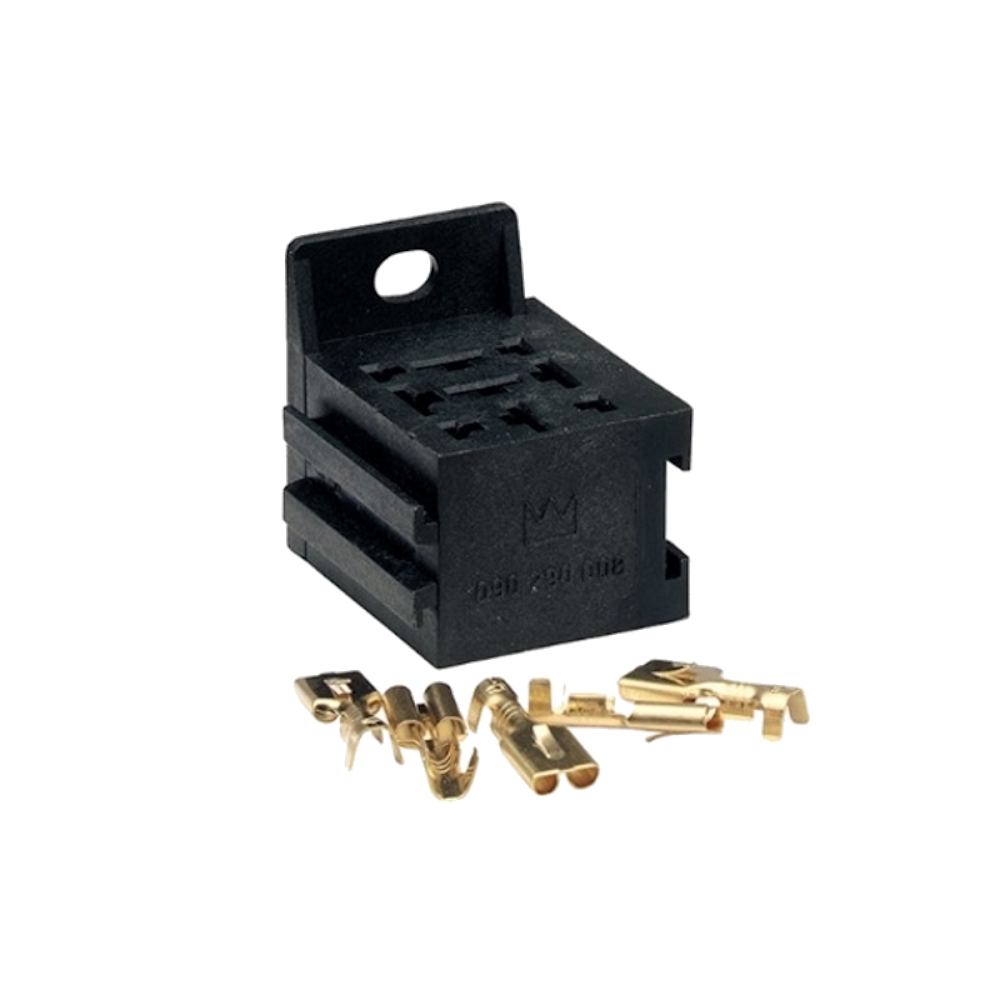
Mini relay base for 4-pin and 5-pin ISO relays. Black thermoplastic housing with pre-formed female blade terminals on the back, side locking clips for stacking the bases front-to-back into a bank.

Britax

Mini Relay Base — 4 & 5 Pin ISO Stackable

99026

Stackable plastic mini ISO relay base. Takes any 4-pin or 5-pin mini relay with 6.3mm female blade terminals pre-formed to the pin pattern (16–14 AWG), 32V DC rated for 12V and 24V automotive circuits.

Fits 4 & 5 Pin ISO
32V DC
6.3mm blades

$6.00

4 interest-free payments of $1.50 with
or finance your build with
We accept
Universal fitmentMini ISO relay base for 12V and 24V DC automotive circuits

Shipping & collection

Worldwide shipping available*
In-store pickup
Professional installation available

*Shipping is calculated at checkout based on your location. Some products can't be delivered to every address.

A plastic base that holds a 4-pin or 5-pin mini ISO relay against the harness instead of wedging it loose behind the dash. Takes 6.3mm female blade terminals on the back, locks the relay body in place by the pin pattern, and keeps the switched circuit tidy. Fits any mini ISO relay, which is the standard body across Narva, Britax, Hella, Tridon and Elevate mini-relay ranges.

The housing is 32 by 28mm and 22mm tall in black thermoplastic, with locking clips on each side that stack bases front-to-back so a bank of relays shares one neat footprint. Each base ships with a set of 6.3mm female blade terminals pre-formed to the correct pin layout, four for 4-pin relays or five for 5-pin. Terminals accept 16 to 14 AWG wire and crimp with a standard automotive crimping tool.

Match the base's current path to the relay above it. The 30 and 87 positions carry the full switched load, so run those legs in the heaviest cable the circuit calls for (around 2.5mm² for a 30A relay, 4mm² for 40A). Fuse the main feed at the battery, not at the relay.

Pairs with
  • Universal Fit — holds any 4-pin or 5-pin mini ISO relay
  • Terminals Included — pre-formed 6.3mm female blades ready to crimp
  • Stackable Housing — clips front-to-back for banked relay installs
  • 6.3mm Blade Pattern — matches the mini ISO pin spacing exactly
  • Accepts 16–14 AWG — covers 1.0mm² to 2.0mm² auto cable
  • 32V DC Rated — covers both 12V and 24V automotive systems
  • Thermoplastic Body — holds up in engine bay and under-chassis locations

Compatibility

Relay Type: Mini ISO

Pin Count: 4 & 5 Pin

Blade Size: 6.3mm female

Cable Gauge: 16–14 AWG

Electrical

Voltage: 32V DC max

Operating Temp: -40 to +85°C

Physical

Dimensions: 32 × 28 × 22mm

Housing: Thermoplastic

Mounting: Stackable clip-together

Weight: 0.03 kg

Length: 32mm

Width: 28mm

Height: 22mm

Weight: 0.22kg

Mini ISO relay base for 12V and 24V DC automotive circuits
12V and 24V DC systems — 4WDs, caravans, trucks, boats, trailers
Fits any 4-pin or 5-pin mini ISO relay (Narva, Britax, Hella, Tridon, Elevate mini-relay ranges)
Stacks front-to-back for banked multi-relay installs
Not for maxi ISO relays — different pin pattern and spacing
Not for 280 Series micro relays — needs a 2.8mm blade socket
Not for mains voltage circuits — 32V DC ceiling

Q: What does mini ISO actually mean?
Mini ISO is the standard body size for small automotive relays (around 28mm cube) with a defined 6.3mm blade-pin pattern on the base. Narva, Britax, Hella, Tridon and Elevate all build to it, which is why a mini ISO relay from one brand drops straight into a mini ISO base from another.

Q: Will any 4-pin or 5-pin mini relay fit this base?
Any relay built to the mini ISO standard will fit. The 4-pin position uses blades 30, 85, 86 and 87; the 5-pin position adds 87a. Both drop into the same base — the fifth socket just sits empty on a 4-pin relay.

Q: What size cable do the terminals accept?
The supplied female blade terminals crimp onto 16 to 14 AWG wire, which is roughly 1.0mm² to 2.0mm² automotive cable — standard sizing for a 20-40A switched circuit. Heavier gauge needs a larger-barrel terminal.

Q: How do I crimp the terminals?
Strip 5-6mm of insulation, slide the wire into the back of the terminal so the insulation lands on the insulation wings and the bare copper lands on the conductor wings, then crimp with a ratchet automotive terminal tool. Pull-test every crimp before pushing the terminal into the base.

Q: Can I stack bases together?
Yes. The side clips lock front-to-back so two, three or more bases share one footprint. Handy when wiring a bank of relays for driving lights, auxiliary circuits or a trailer brake controller feed.

Q: What is the current rating of the base?
The base itself passes the current through its blade terminals, so the rating matches whatever the terminals can carry — industry standard is around 30A continuous on 6.3mm female blades with 16-14 AWG wire. The real-world ceiling is set by the relay and the cable above it, not the base.

Q: Does the base need fusing?
The feed into the relay (pin 30) does, yes — and it goes at the battery end, not between the base and the load. Size the fuse one step above the switched load's working current and under the cable's rated capacity.

Q: Why use a relay base at all?
A base keeps the relay off the harness, holds the wiring in a known pin layout, and makes a dead relay a 30-second swap instead of a solder-and-heatshrink job. It also lets a bank of relays live together neatly behind a dash or inside a fuse-box panel.

Q: Can I use this with a micro relay?
No. Micro relays use a 280 Series pattern with 2.8mm blades on tighter centres — a different socket. This base is mini ISO only, which uses 6.3mm blades on wider centres.

Q: What's the difference between a relay base and a relay socket?
They describe the same thing in AU auto-electrical catalogues — the plastic housing that holds the relay and takes the harness terminals. "Base" is the more common AU label; "socket" shows up more on international datasheets.

Q: Can I use this in a 24V system?
Yes. The base is rated to 32V DC, so it covers 12V and 24V automotive circuits with headroom. Just make sure the relay sitting in it carries a 24V coil to match the system voltage.

Q: Can I bolt the base to a bulkhead directly?
The housing itself clips rather than bolts — there's no mounting ear or hole. Stack a bank of bases together and secure the stack with a cable tie around a chassis stud, or sit the stack inside a fuse box panel that holds it in place.

Join our community.