EA-Logo-RGB-Master_Yellow-Dark-Grey-Black


Currency

Cart 0

SIGN UP FOR $10 OFF YOUR FIRST ORDER

Sorry, looks like we don't have enough of this product.

Pair with
Estimate shipping
Add order notes
Is this a gift?
Subtotal Free
View cart
Shipping, taxes, and discount codes are calculated at checkout

Your Cart is Empty

Home / Lighting / Driving & light bars
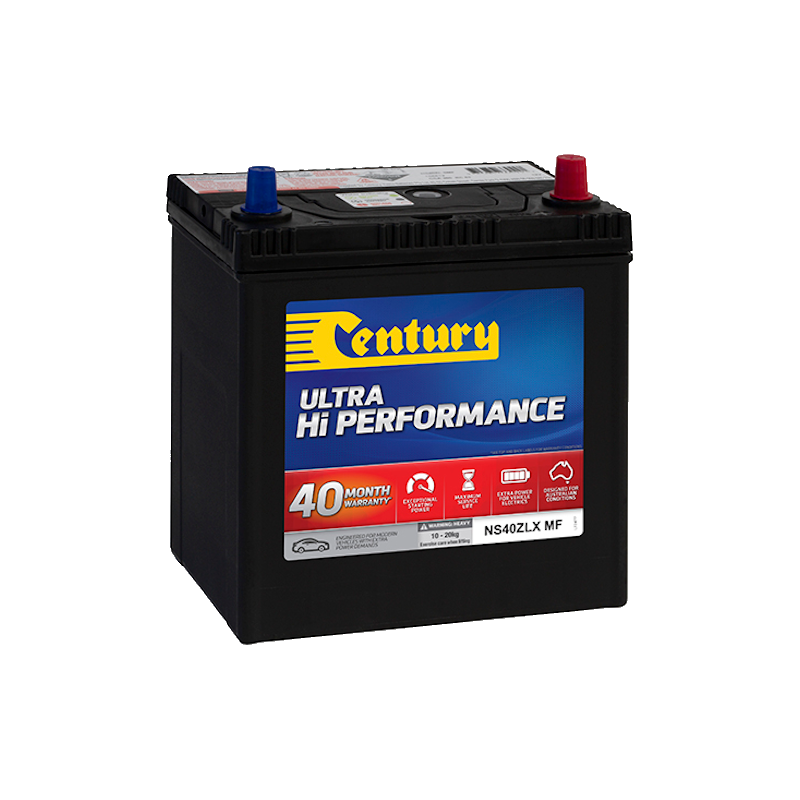

Century NS40ZLX MF Ultra Hi Performance 12V 400CCA battery, calcium wet-cell, maintenance-free lid with state-of-charge indicator, C polarity positive terminal on the left, SP small-post tapered terminals, NS40Z tray footprintPolarity diagram of a six-cell 12 volt battery seen from above, positive terminal at the left and negative at the right, labelled 12 Volt C Polarity – Century batteryLine drawing of a small tapered lead battery post, labelled Small Terminal Post (SP) – Century batteryNS40ZLX MF Century Ultra Hi Performance Battery 400CCA 70RC 42AH - view 4

Century

NS40ZLX MF Ultra Hi Performance Battery — 12V 400CCA 42Ah

105165

Australian-made Century NS40ZLX MF Ultra Hi Performance 12V starter battery. 400 CCA, 70 min reserve, 42Ah, C polarity, small-post terminals. Fits Japanese petrol imports on the NS40Z tray. 40-month warranty.

$175.00

4 interest-free payments of $43.75 with
or finance your build with
We accept
Fits Japanese petrol imports on the NS40Z footprint. Confirm the tray size, polarity and terminal post before ordering.

Shipping & collection

Worldwide shipping available*
In-store pickup
Professional installation available

*Shipping is calculated at checkout based on your location. Some products can't be delivered to every address.

An Australian-made calcium wet-cell starter battery sized to the NS40Z tray, with C polarity (positive terminal on the left) and small-post (SP) tapered terminals. Fits Japanese petrol imports that run on the NS40Z footprint, including earlier Toyota Hilux and Hiace petrol, Mazda B-Series petrol, Nissan Navara petrol and Ford Courier petrol. Sibling to the NS40ZL MF on the standard Hi Performance line and the NS40ZX MF D-polarity mirror for cars where positive sits on the right.

Delivers 400 cold cranking amps and 70 minutes of reserve capacity at 25 amps from a 42Ah C20 pack built around calcium plates with Platelock holding the stack together under vibration. The flame-arrested lid carries a built-in state-of-charge indicator and moulded carry handles, sits on a mud-rack base, and drops into the NS40Z tray at 195 by 127 by 200 mm (220 mm over the posts) at 10.3 kg bare.

This is a flooded calcium wet-cell starter battery, not AGM, not EFB and not dual-purpose deep-cycle. Fit it to the designated starter position only, run engine-start loads rather than long auxiliary cycling, and if two are paired in 24V series match them by age and state of charge before coupling. Charger profile is standard flooded wet-cell (14.4 to 14.7V bulk, 13.5 to 13.8V float at 20°C) with temperature compensation; do not use AGM, Gel or Lithium profiles on this battery.

What sets it apart

Century rates the Ultra Hi Performance line at 15 percent more cold-cranking power and 30 percent longer service life than the standard Hi Performance NS40ZL MF, driven by a heavier calcium plate pack and the Platelock internal brace. Mud rack and plate-locking combine with double-insulated separators and a flame-arrested lid to handle the vibration, heat and sloshing of 4WD, caravan tow and tray-truck duty cycles that the standard tier is not warranted for. Carries a 40-month Century warranty against manufacturing defects, ten months longer than the standard Hi Performance NS40ZL MF.

Charging, mounting and fusing

Charge on a flooded wet-cell profile at 14.4 to 14.7V bulk and 13.5 to 13.8V float at 20°C, with temperature compensation of around minus 18 mV per degree C above or below 20°C. The mud-rack base saddles the NS40Z tray without an adapter plate; torque the hold-down clamp to vehicle manufacturer spec (typically 5 to 8 Nm on a Toyota hook-down bar). Fuse at the starter cable rather than at the terminal, size to cranking current, and if coupling two in 24V series match age and resting state of charge within 10 percent before parallel-cabling. European marques built from 2008 onward with Battery Management Systems need a BMS reset after replacement so the alternator profile reprograms to the new battery age; the NS40Z footprint doesn't typically land in those cars, but worth checking if the car is a European-built van or ute conversion.

  • 400 CCA — 15% over Hi Performance tier
  • 70 min reserve — 25A continuous at 20°C
  • 42Ah C20 — standard-rate capacity figure
  • Platelock bracing — plates locked for vibration
  • Mud-rack base — fits NS40Z tray natively
  • Flame-arrested lid — ignition-safe venting
  • State-of-charge eye — green, dark or clear check
  • Australian made — built for AU heat and dust

Electrical

Voltage: 12V DC

Cold Cranking Amps: 400 A (SAE J537)

Reserve Capacity: 70 min at 25A

Capacity: 42 Ah at C20

Chemistry: Calcium wet-cell

Build

Polarity: C (positive left)

Terminal: SP (small post, tapered)

Base: NS40Z, mud rack

Length195 mm
Width127 mm
Height200 mm (220 mm over posts)
Weight10.3 kg

Installation on an NS40Z tray takes about 20 minutes with the vehicle in the shade. Disconnect the negative terminal first, then the positive, and lift the old battery out with the carry handles. Clean the tray and both cable lugs with a wire brush, then apply a thin smear of petroleum jelly to the posts after fitting. Drop the new battery into the tray with the positive terminal on the LEFT (C polarity), seat it against the mud-rack base, and torque the hold-down clamp to vehicle spec (typically 5 to 8 Nm). Reconnect positive first, then negative.

Check the resting voltage after install reads 12.6V or higher. If the vehicle is European-built from 2008 onward with a Battery Management System, scan-tool a BMS reset so the alternator profile reprograms to the new battery age. This is uncommon on NS40Z-fit vehicles but worth checking on van or ute conversions.

Fuse the main starter cable at a size matching cranking current, not at the battery terminal itself (adds a point of failure directly on the post). Keep auxiliary and starter circuits on separate buses so a flat auxiliary doesn’t crank the starter down.

Store a spare on a trickle charger at 13.5 to 13.8V to maintain state of charge. Flooded calcium batteries self-discharge about 3 to 5 percent per month at 20°C; left unused for six months the resting voltage drops below the point where sulfation starts.

Fits Japanese petrol imports on the NS40Z footprint. Confirm the tray size, polarity and terminal post before ordering.
C polarity (positive terminal left)
SP small-post tapered terminals
12V single-battery and 24V series starter systems (match age and SOC before pairing in 24V)
Not for D polarity, use NS40ZX MF for positive-right wiring
Not for standard-post vehicles, confirm post sizing before ordering
Not for ISS stop/start, use EFB or AGM battery for cycling duty
Not for deep-cycle auxiliary duty, use a dedicated deep-cycle battery

Q: What does NS40ZLX actually mean?
NS40Z is the Japanese tray footprint (195×127×200 mm). L marks left-hand polarity (positive terminal on the left). X marks the Ultra Hi Performance tier (above the standard NS40ZL Hi Performance line). MF means maintenance-free sealed lid.

Q: What does CCA mean, and why does 400 matter?
Cold Cranking Amps is the current the battery delivers at minus 18°C for 30 seconds without dropping below 7.2 volts. 400 CCA is the SAE J537 standard rating. For context, the sibling NS40ZL MF on the standard line rates 330 CCA, so the Ultra Hi Performance line gives you about 15 percent more cranking headroom for the same tray size.

Q: What is reserve capacity (RC) in minutes?
RC is how many minutes the battery can deliver 25 amps continuous without dropping below 10.5 volts at 25°C. 70 minutes means a stalled vehicle with ignition, headlights and radio on will keep running for just over an hour before the battery hits cut-off. Useful figure for breakdown scenarios and short auxiliary runs.

Q: Will this fit my car?
If your current battery is marked NS40Z or NS40ZL and your positive terminal sits on the LEFT when looking at the battery from the front, this fits. Check the SP (small post) terminal is right for your cable lugs. Common fitment includes earlier Toyota Hilux and Hiace petrol, Mazda B-Series petrol, Nissan Navara petrol and Ford Courier petrol. Confirm against the Century battery finder before ordering.

Q: What is the difference between NS40ZL MF and NS40ZLX MF?
Same tray, same polarity, same terminals. The LX sits on the Ultra Hi Performance line (400 CCA, 70 min RC, 40-month warranty, Platelock and mud rack); the L is standard Hi Performance (330 CCA, 60 min RC, 30-month warranty). If the car is on lower-km suburban duty the base NS40ZL is fine; for heat, 4WD, caravan tow or tray-truck duty the LX earns its place.

Q: What is C polarity vs D polarity?
C polarity means the positive terminal is on the LEFT when looking at the battery with the terminals facing you. D polarity is positive on the RIGHT. Vehicles are wired for one or the other, so fitting the wrong polarity makes the main cables reach the wrong terminals. If your car needs positive on the right, choose the NS40ZX MF instead.

Q: What is SP terminal vs STD terminal?
SP is small post (tapered Japanese standard post) typically found on NS-series Japanese batteries. STD is the standard (larger) post found on DIN-series and some NS variants. Cable lugs are sized to one or the other, so forcing the wrong lug makes a bad connection that heats up under cranking current.

Q: Can I pair two of these in 24V series?
Yes, for engine-start applications where the vehicle is factory-wired 24V (24V truck conversions, some marine starters). Match age and resting state-of-charge within 10 percent before pairing. Mismatched batteries pull each other toward the weaker one and shorten service life.

Q: Does this suit an ISS stop/start car?
No. Stop/start duty cycles need EFB or AGM batteries built for repeated deep-ish discharge and recharge over short intervals. A calcium flooded wet-cell will fail early in that duty cycle. If your car has stop/start, choose an EFB or AGM at the correct NS40Z tray size instead.

Q: What is the service life?
40 months warranty against manufacturing defects, 4 to 6 years typical calendar life in Australian conditions with correct install and healthy charging. Heat shortens life; underbonnet temperatures above 60°C sustained will knock a year or two off the figure. In a shaded boot or tub installation the top of the window is realistic.

Join our community.