EA-Logo-RGB-Master_Yellow-Dark-Grey-Black


Currency

Cart 0

SIGN UP FOR $10 OFF YOUR FIRST ORDER

Sorry, looks like we don't have enough of this product.

Pair with
Estimate shipping
Add order notes
Is this a gift?
Subtotal Free
View cart
Shipping, taxes, and discount codes are calculated at checkout

Your Cart is Empty

Home / Lighting / Driving & light bars
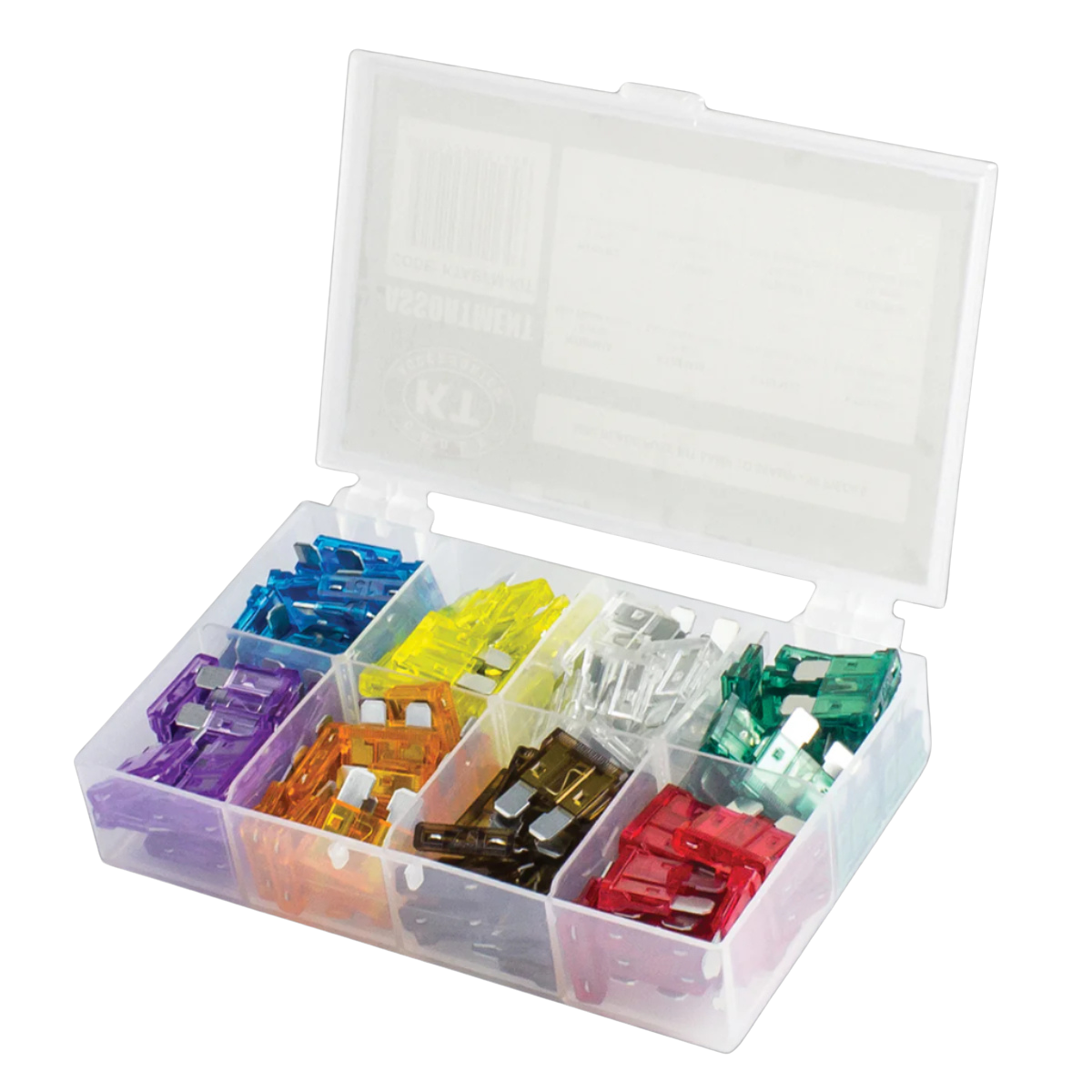
Assorted 120-piece Standard blade fuse kit — 15 each of 3A, 5A, 7.5A, 10A, 15A, 20A, 25A and 30A colour-coded automotive fuses in a plastic organiser

Elevate Automotive

Standard Blade Fuse Kit — 120 Pieces Assorted

KTABF-KIT

120-piece assorted Standard blade (ATC/ATO) fuse kit, 15 each of 3A, 5A, 7.5A, 10A, 15A, 20A, 25A and 30A. Colour-coded, rated up to 32V DC for 12V and 24V circuits.

Fuse typeStandard blade
Range3A–30A
VoltageUp to 32V DC

$49.00

4 interest-free payments of $12.25 with
or finance your build with
We accept
Universal fitmentStandard blade (ATC/ATO) fuses for 12V and 24V DC circuits.

Shipping & collection

Worldwide shipping available*
In-store pickup
Professional installation available

*Shipping is calculated at checkout based on your location. Some products can't be delivered to every address.

A 120-piece Standard blade fuse tin that keeps a full working range of automotive spares in one drawer. Carries 15 fuses each in 3A, 5A, 7.5A, 10A, 15A, 20A, 25A and 30A, colour-coded to the industry-standard shades so ratings read at a glance. Fits any Standard blade holder, block, panel or inline holder across 4WDs, caravans, boats, campers and workshop utes.

These are Standard blade fuses (also written ATC, ATO or ATS), the medium-size family that sits between smaller Mini/Micro2 and larger Maxi. Each fuse plugs into a standard blade slot and physically breaks the circuit the moment current exceeds its rating, protecting the wiring downstream from an overload or short. The tin sorts the eight sizes into separate bays so the right rating pulls out cleanly rather than being fished from a pile.

Rated to 32V DC per SAE J1284, so covers every 12V and 24V DC vehicle circuit. Not rated for 48V DC (needs a 58V-rated fuse) or for mains AC (needs a mains cartridge fuse). Match the fuse rating to the wire's carrying capacity and the accessory's normal running current, not to the biggest fuse that fits.

Other blade fuse kits in our range

If your circuits need bigger fuses, or a mix of families in one kit:
  • Eight sizes — 3A through 30A in one tin
  • Colour-coded — industry-standard shade per rating
  • 32V DC rated — safe on 12V and 24V circuits
  • SAE J1284 — built to the automotive standard
  • 15 of each size — working stock not one-and-done
  • Universal fit — blocks, holders, panels, inline

Fuse

Type: Standard blade

Amperage range: 3A–30A

Voltage rating: Up to 32V DC

Standard: SAE J1284
Standard blade (ATC/ATO) fuses for 12V and 24V DC circuits.
12V and 24V DC systems (fuses rated to 32V DC per SAE J1284)
Not for 48V DC systems, use a 58V DC-rated blade fuse instead
Not for mains AC, use a mains cartridge fuse instead

Q: What size are these fuses, Standard, Mini or Micro?
These are Standard blade fuses (also written ATC, ATO or ATS), the medium-size automotive family. They're bigger than Mini (ATM) and much bigger than Micro2 (APT). Newer cars often use Mini or Micro2 in the dash, pull one of your existing fuses and compare shape before you buy.

Q: What voltage systems are these safe on?
Standard blade fuses are rated to 32V DC per SAE J1284. That covers 12V and 24V DC systems safely. They're not rated for 48V DC systems, use a 58V-rated fuse there, and they're not rated for mains AC at all.

Q: Why are they colour-coded?
Every Standard blade fuse rating has a fixed industry-standard colour, so you can identify a fuse's amperage at a glance without pulling it out to read the number, useful when you're checking under a dash with a torch. In this kit: 3A violet, 5A tan, 7.5A brown, 10A red, 15A blue, 20A yellow, 25A clear/natural, 30A green.

Q: How do I pick the right amperage for a circuit?
Fuse to the wiring, not to the accessory's peak. A common rule of thumb: pick the smallest fuse that comfortably carries the accessory's normal running current (about 125% of it) while still being well below the wire's own current rating. If the accessory is fused by the manufacturer, use the size they specify.

Q: What happens if I use a fuse with too high an amperage?
The wiring becomes the fuse. A fuse rated well above what the wire can carry lets a fault current flow long enough to overheat the insulation or the wire itself, that's a melted loom, a burnt connector, or worst case a fire. Always size the fuse to the wire and the accessory, not to whatever's in the drawer.

Q: What happens if I use a fuse with too low an amperage?
The circuit works until you turn on the accessory, then the fuse pops, sometimes immediately, sometimes after a few minutes when a motor draws its startup current. Nothing dangerous, just annoying. Step up one rating and try again.

Q: Where can Standard blade fuses go?
Anything that takes a Standard blade fuse holder, vehicle fuse boxes, aftermarket fuse blocks, inline weatherproof fuse holders, dedicated blade fuse panels. If your holder or block accepts a plug-in Standard blade, these fit.

Q: How do I tell if one has blown?
Hold it up to the light, there's a small clear window across the top showing the metal element inside. If the element is bent but continuous, it's fine; if there's a visible gap in it, the fuse is blown. A multimeter across the two prongs (with the fuse out of the circuit) is the definitive test.

Q: Can I re-use a blown fuse if it looks fine?
No, replace with a new one of the same rating. A fuse that has blown has been thermally stressed even if the element looks intact; its behaviour on the next fault won't be reliable. That's what the kit is for.

Q: Why did my fuse blow in the first place?
One of three things: (a) the accessory is drawing more current than the fuse allows, upsized wiring might be needed, and a bigger fuse to suit; (b) a wire or connection somewhere in that circuit has shorted to earth; (c) the accessory itself has failed and is drawing a fault current. Don't just fit a bigger fuse without finding out which one it is.

Join our community.