EA-Logo-RGB-Master_Yellow-Dark-Grey-Black


Currency

Cart 0

SIGN UP FOR $10 OFF YOUR FIRST ORDER

Sorry, looks like we don't have enough of this product.

Pair with
Estimate shipping
Add order notes
Is this a gift?
Subtotal Free
View cart
Shipping, taxes, and discount codes are calculated at checkout

Your Cart is Empty

Home / Lighting / Driving & light bars
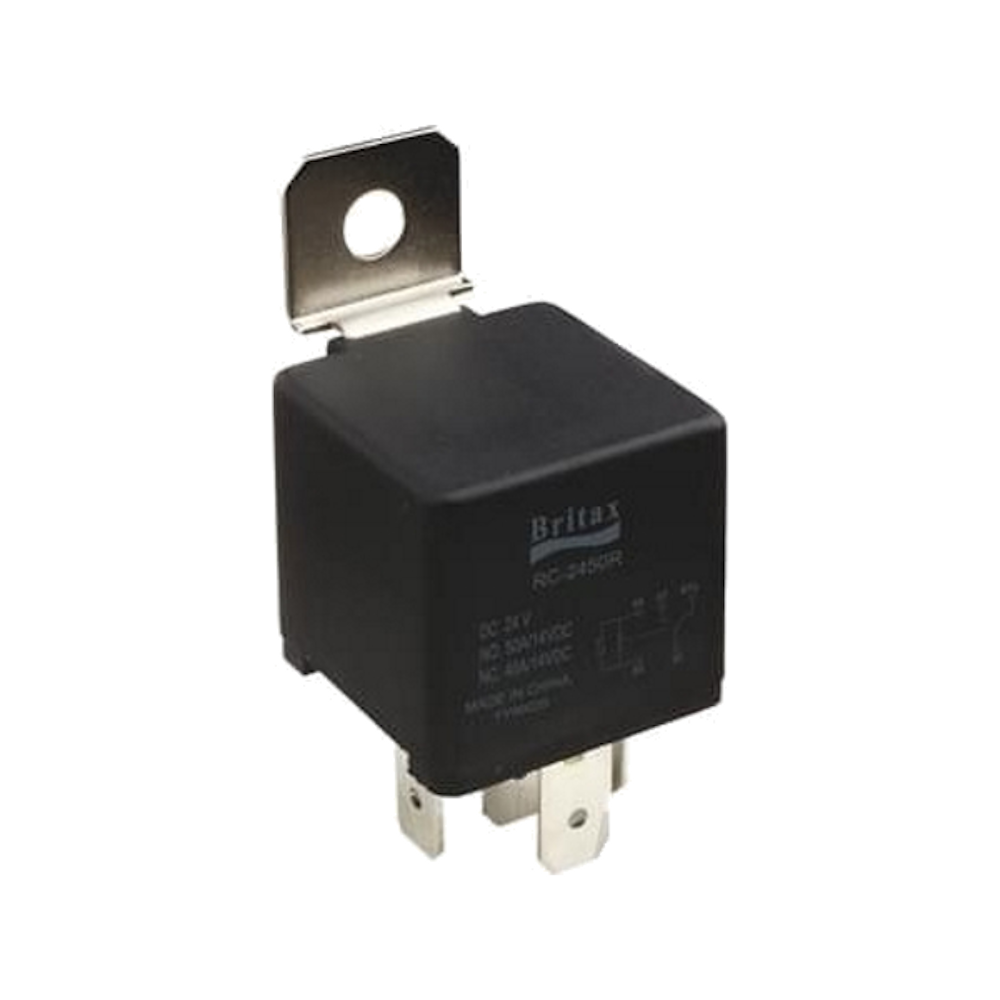
Britax RC-1240R mini changeover relay with 5-pin 280 Series base, 12V 40A/30A rating with resistor protectionBritax RC-1240R mini relay dimensions diagram showing 280 Series pin layout

Britax

Mini Changeover Relay — 12V 40A/30A 5-Pin Resistor Protected

RC-1240R

5-pin mini changeover relay for 12V automotive switching. 40A through the N/O side, 30A through the N/C side. Resistor protected, 280 Series base.

40A N/O
30A N/C
12V DC

$14.00

4 interest-free payments of $3.50 with
or finance your build with
We accept
Universal fitment5-pin mini changeover relay for 12V automotive systems.

Shipping & collection

Worldwide shipping available*
In-store pickup
Professional installation available

*Shipping is calculated at checkout based on your location. Some products can't be delivered to every address.

A 5-pin mini changeover relay that switches two circuits off one trigger: 40A through the normally-open side, 30A through the normally-closed. Runs driving lights, electric cooling fans, horn upgrades, headlight boost circuits and auxiliary feeds that need high-current switching off a low-current switch. Fits any 12V vehicle wiring loom with a standard 280 Series mini relay socket.

A built-in resistor across the coil absorbs the back-EMF spike every time the coil switches off, protecting delicate electronics upstream. The housing is roughly 28mm per side and the five 6.3mm blade pins seat into any 280 Series mini relay base. Rated for 500,000 switching cycles and an operating temperature of -40°C to +85°C.

Pick the contact that matches the load direction. Use the N/O side for anything that stays off until triggered, like driving lights or a horn. Use the N/C side for anything that stays on until triggered, like an interlock that cuts an accessory when another system turns on. Fuse every circuit at the source, not at the relay.

You'll also need
Pairs with
  • 40A/30A changeover
  • Resistor protected — absorbs the coil back-EMF spike to protect ECUs and sensitive electronics.
  • 5-pin 280 Series — fits any standard mini relay socket or wiring harness.
  • 500,000 cycle rating — long service life for high-frequency switching.
  • Wide operating range — -40°C to +85°C covers every AU climate.
  • Compact footprint — roughly 28mm per side, fits tight engine-bay spaces.
  • 12V nominal — pairs with any standard 12V automotive system.

Electrical

Operating Voltage: 12V DC

Contact N/O: 40A

Contact N/C: 30A

Coil Current: 0.15A

Protection: Resistor

Cycles: 500,000

Physical

Pin Count: 5

Pin Pattern: 280 Series

Dimensions: 28×28×28mm

Weight: 40g

Operating Temp: -40 to +85°C
Length: 26mm

Width: 26mm

Height: 25mm

Weight: 0.1kg

5-pin mini changeover relay for 12V automotive systems.
12V DC systems — cars, 4WDs, caravans, marine, trailers
24V systems — use a 24V-rated relay instead
Loads above 40A on the N/O side or 30A on the N/C side — use a heavy-duty relay or solenoid

Q: What does 'changeover' mean on a relay?
A changeover relay has two switched circuits sharing one trigger. One contact is normally open (N/O) and closes when the coil energises; the other is normally closed (N/C) and opens when the coil energises. Flip the trigger, both circuits swap state at once.

Q: What's the difference between N/O and N/C contacts?
N/O (normally open) sits open until the coil energises, then closes to let current flow. Use it for loads that stay off until triggered: driving lights, horn, a radiator fan on demand. N/C (normally closed) sits closed and lets current flow until the coil energises, then opens. Use it for loads that stay on until triggered: an interlock that cuts an accessory when another system turns on.

Q: Why is the N/O rated higher than the N/C?
Contact pressure. Mini changeover relays spring the common pin against the N/C contact at rest, which is a lighter pressure than the magnetic pull that closes the N/O when energised. More pressure means lower resistance and higher current capacity. 40A N/O and 30A N/C is the industry norm across mini changeover relays.

Q: What does '280 Series' mean?
It's the pin spacing standard for mini ISO automotive relays. Pins are 6.3mm wide spade terminals on the 280 pattern layout. Any socket or wiring harness labelled '5-pin mini relay' or '280 Series' will seat this relay.

Q: What does 'resistor protected' do?
There's a resistor wired across the coil. When the coil switches off, the collapsing magnetic field would otherwise spike several hundred volts back down the trigger wire; the resistor bleeds that energy off harmlessly. Protects any ECU, body computer or trigger module upstream.

Q: Can I use this on a 24V system?
No. The coil is wound for 12V and will burn out on 24V within minutes. Use a 24V-rated relay for 24V trucks and gear.

Q: What's the difference between a mini and a micro relay?
Mini relays are the larger industry-standard 280 Series body (~28mm per side, 6.3mm pins). Micro relays are smaller 180 Series (~15mm per side, 2.8mm pins) and usually sit in modern vehicle fuse boxes. The two are not interchangeable — different socket, different pin pattern.

Q: Do I need a separate relay socket?
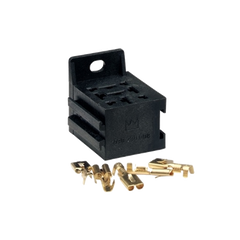
If your wiring loom already has a 5-pin mini relay socket, the relay plugs straight in. If you're wiring from scratch, you'll want a mini relay base with crimp terminals — we sell one that fits this relay (linked above).

Q: How much current does the coil itself draw?
Around 0.15A at 12V (roughly 1.8W), which is low enough for any dash switch or ECU output to drive without a secondary relay or load resistor.

Q: What size fuse should protect the switched circuit?
Fuse at or just above the actual load, not at the relay's maximum rating. A pair of 55W driving lights draws about 10A, so fuse at 15A. A 20A radiator fan fuses at 25A. The relay's 40A ceiling is the limit, not the recommended fuse size.

Q: Can this run my winch or inverter?
No. Winches pull 200–500A under load and inverters above 1000W draw 80A+ — both far beyond this relay's 40A ceiling. Use a heavy-duty 80A+ relay or a solenoid rated for the actual load.

Q: How long will it last?
Rated for 500,000 switching cycles at full load, which is well over a decade of daily switching in typical automotive use. Cycle life drops as the load approaches the rated maximum — running at 20A gives roughly double the cycles of running at 40A.

Join our community.