EA-Logo-RGB-Master_Yellow-Dark-Grey-Black


Currency

Cart 0

SIGN UP FOR $10 OFF YOUR FIRST ORDER

Sorry, looks like we don't have enough of this product.

Pair with
Estimate shipping
Add order notes
Is this a gift?
Subtotal Free
View cart
Shipping, taxes, and discount codes are calculated at checkout

Your Cart is Empty

Home / Lighting / Driving & light bars

Fujiya ESD side cutters 135mm with flush-cut blades and electrostatic-dissipative black elastomer grips, spring-loaded return

Fujiya

ESD Side Cutters — 135mm Flush Cut

MTN03E-135

Fujiya precision side cutters for electronics. Flush-cut blades, ESD-dissipative grips, 65g, Ø0.8mm steel / Ø1.3mm copper.

Length: 135mm
Cut: Flush
Grips: ESD

$99.00

4 interest-free payments of $24.75 with
or finance your build with
We accept
Universal fitmentESD-safe precision work on 12V, 24V, 36V and 48V electronic systems

Shipping & collection

Worldwide shipping available*
In-store pickup
Professional installation available

*Shipping is calculated at checkout based on your location. Some products can't be delivered to every address.

A precision Japanese side cutter with a flush-cut blade and electrostatic-dissipative resin grips. Trims component leads flush to the PCB, cuts fine signal wire, and clips zip-tie tails without transferring static charge to sensitive electronics. Fits any workbench handling microcontrollers, LED strips, car-ECU repairs, dashcam installs, VE.Direct and CAN-bus wiring.

The 135mm body balances in one hand for repetitive work. Blades are straight and ground flush so cut leads sit level with the solder joint, with a return spring that opens the jaws between cuts and a stopper that prevents overtravel. The handles are elastic polymer with built-in ESD conductivity, so the tool bleeds static to whatever grounded surface it rests on.

Cutting capacity is Ø0.8mm steel wire and Ø1.3mm copper wire, the limits of a precision cutter rather than a cable cutter. Rated well above that for component leads but not for cable above 10 AWG or terminal shanks. For larger copper, step up to our forged-steel cable cutter.

Pairs with
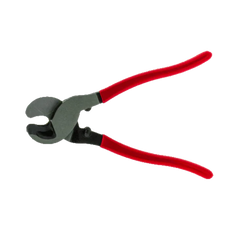
  • Flush-cut blades — trims leads level with the PCB
  • ESD-safe grips — bleeds static safely to ground
  • Return spring — handles reopen between cuts
  • Blade stopper — prevents overtravel into the pivot
  • 135mm body — balanced one-hand use
  • RoHS2 compliant — safe for export markets

Build

Length: 135mm

Weight: 65 g

Blade material: Carbon steel

Blade finish: Chemical black

Handles: ESD elastomer

Spring: Return with stopper

Operation

Steel wire: Ø0.8mm

Copper wire: Ø1.3mm

Cut profile: Flush

ESD rating: Dissipative

Compliance: RoHS2

Length: 200mm

Width: 73mm

Height: 17mm

Weight: 0.2kg

ESD-safe precision work on 12V, 24V, 36V and 48V electronic systems
Automotive ECU, dashcam, lighting, VE.Direct and CAN-bus wiring
Caravan and 4WD inverter, DC-DC and MPPT board rework
Not for cable above Ø1.3mm copper, use a dedicated cable cutter

Q: What does ESD safe actually mean?
A: ESD stands for electrostatic discharge, the tiny shock that leaves your finger when you touch metal in dry weather. For a person it is nothing; for a microcontroller or MOSFET it can blow the gate silently. ESD-safe cutters have conductive handles that keep you and the tool at the same potential as whatever grounded surface they are resting on, so no sudden discharge jumps through a part when the blades touch it.

Q: Can I cut copper cable with these?
A: No. The copper capacity is Ø1.3mm (around 16 AWG solid), which covers component leads, hookup wire and jumper wire. For automotive cable from 6mm² up, use a dedicated cable cutter: [jaylec-cable-cutter-60mm2-forged-steel] handles everything from 6mm² to 60mm² without crushing the strands.

Q: What is a flush cut?
A: Standard side cutters leave a small pyramid stub on the cut end. Flush cutters have one blade ground almost flat so the cut sits level with the surface. On a PCB that means the lead ends at the solder joint instead of standing proud, which stops it catching on housings or shorting against neighbouring components.

Q: Will they cut piano wire or steel strap?
A: The maximum steel capacity is Ø0.8mm. Piano wire up to about 0.8mm is fine, anything thicker will mark or chip the blades. Hardened spring steel, cable strands with a steel core, or anything structural needs a dedicated hard-wire cutter.

Q: What vehicles and work are these for?
A: Anywhere electronics are being modified or repaired. ECU reflashes, dashcam and radar install, VE.Direct and CAN-bus wiring on caravan setups, LED strip builds, PCB rework on inverters and MPPTs. Handy for anyone doing fine 12V work who needs a cutter that will not fry what they are working on.

Q: Is the spring removable?
A: No, the return spring is built into the pivot. It is there to open the jaws between cuts so you can work quickly one-handed. If you prefer a non-spring cutter for slow precision work, that is a different tool.

Q: Why are these more expensive than a hardware-store side cutter?
A: Three reasons. First, the grips are a specific ESD-dissipative polymer, not plain rubber. Second, the blades are ground flush with a tight pivot that keeps the cut square after thousands of cycles. Third, Fujiya make hand tools in Japan to the same quality tier as Knipex (Germany) or Engineer (also Japan); trade users specify them because the geometry stays true after years of daily use.

Q: Can I use these on a bench without an ESD mat?
A: You can, but the ESD protection only works when the tool is connected to a common ground. On a proper ESD workbench the mat, wrist strap and tool all share the same path to earth. On a kitchen table they are still better than non-ESD cutters, but discharge events can still happen through the component itself.

Q: Are the blades replaceable?
A: No, the blades are integral to the body. These are a sealed precision tool rather than a serviceable one; when the edges finally dull after years of use, replace the whole cutter.

Q: How do they compare to Engineer NS-06 or CK ESD cutters?
A: Engineer NS-06 is a smaller micro cutter (around 110mm) with an undercut blade designed for recessed work. CK's ESD range is similar in size to this Fujiya but typically uses a different grip polymer. The Fujiya MTN03E-135 sits in the middle: longer than the Engineer micro so it covers general wiring too, flush rather than undercut, with the Fujiya return spring that trade users prefer for repetitive work. Pick based on how much recessed work you do versus general lead trimming.

Join our community.