EA-Logo-RGB-Master_Yellow-Dark-Grey-Black


Currency

Cart 0

SIGN UP FOR $10 OFF YOUR FIRST ORDER

Sorry, looks like we don't have enough of this product.

Pair with
Estimate shipping
Add order notes
Is this a gift?
Subtotal Free
View cart
Shipping, taxes, and discount codes are calculated at checkout

Your Cart is Empty

Home / Lighting / Driving & light bars
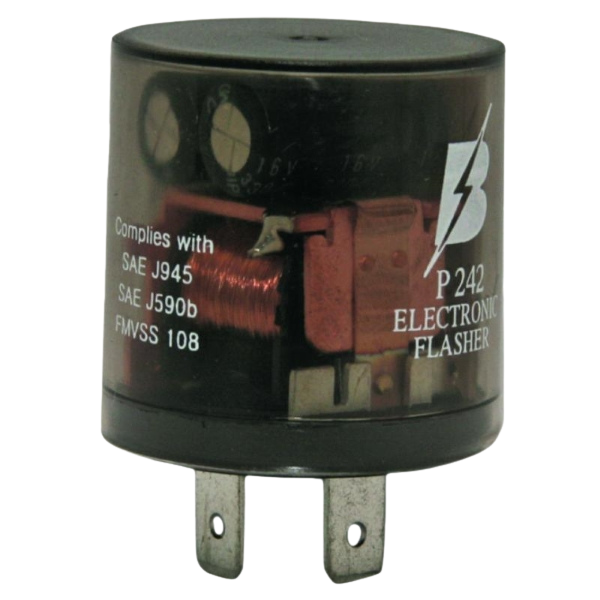
24V 2 Pin Flasher Relay, 20A electromechanical thermal flasher with 2 x 6.3mm blade terminals numbered 49 and 49a to DIN 72552, for truck, bus and heavy vehicle indicator and hazard circuits.

Elevate Automotive

24V 2 Pin Flasher Relay — 20A Electromechanical for Trucks & Buses

P242

24V 2-pin electromechanical flasher relay for indicator and hazard circuits on trucks, buses, caravans and agricultural machinery. 20A continuous, drives up to 10 × 21W of filament globes, DIN 72552 pin numbering, no pilot output.

Rating20A · 24V DC
Load10 × 21W max
Pins2 · DIN 72552

$40.00$48.00 Save $8

4 interest-free payments of $10.00 with
or finance your build with
We accept
Universal 24V fitment24V 2-pin electromechanical flasher relay for indicator and hazard warning circuits on trucks, buses, caravans, trailers and agricultural machinery with 24V electricals.

Shipping & collection

Worldwide shipping available*
In-store pickup
Professional installation available

*Shipping is calculated at checkout based on your location. Some products can't be delivered to every address.

A 24V thermal flasher relay that drives the indicator and hazard circuits on heavy vehicles from a 2-pin socket. Feeds the globes directly off terminal 49a from the bimetal strip inside, so the dash side gets a plain on/off pulse at 60 to 120 flashes per minute. Fits trucks, buses, caravans with 24V systems, agricultural machinery and plant that still runs filament indicator globes.

Housing is a sealed thermal bimetal unit about 30 by 30 by 41mm with a pair of 6.3mm blade terminals numbered 49 (feed) and 49a (lamps) to DIN 72552. Rated to 20A continuous. Not polarity sensitive so it drops into positive or negative chassis vehicles. Pin numbering matches the OE socket on most Isuzu, Hino, Fuso, UD, Mack, Kenworth and Freightliner cabs built with 24V electricals.

Load-rate the circuit for whatever filament globes are wired to it. Four indicator globes plus matching trailer globes under one circuit stays well inside the 10 × 21W ceiling; LED indicator strips without a load resistor will drop the current below the thermal threshold and leave the flasher idle or hyper-flashing. If the vehicle has a dash tell-tale pilot lamp, use the 3-pin version instead; this 2-pin unit has no pilot output.

Pairs with

  • 20A rating — handles 10 × 21W filament globe load
  • 24V thermal — bimetal strip drives steady 60-120 FPM flash
  • DIN 72552 — pins 49 and 49a match OE socket wiring
  • 2-pin spade — 6.3mm blade terminals for straight-in connection
  • Polarity free — works on positive and negative chassis vehicles
  • Blown globe — flash rate slows as a built-in fault signal
  • Compact body — 30 × 30 × 41mm sealed thermal unit

Electrical

Rating | 20A continuous

Voltage | 24V DC

Load capacity | 10 × 21W

Flash rate | 60-120 FPM

Globe type | Filament

LED direct | Needs resistor

Polarity | Not sensitive

Physical

Dimensions | 30 × 30 × 41mm

Weight | ~40g

Terminals | 2 × 6.3mm blade

Pin numbers | 49, 49a

Operating temp | -30 to +85°C

Design | Thermal bimetal
Length: 30mm

Width: 30mm

Height: 41mm

Weight: 0.12kg

24V 2-pin electromechanical flasher relay for indicator and hazard warning circuits on trucks, buses, caravans, trailers and agricultural machinery with 24V electricals.
24V DC indicator and hazard circuits with 2-pin OE sockets
Filament indicator globes up to 10 × 21W total load
Positive and negative chassis vehicles
12V vehicles (will not switch; use a 12V equivalent)
LED indicator strips without a load resistor (sits idle or hyper-flashes)
Vehicles with dash pilot/tell-tale lamp (needs a 3-pin flasher with pilot output)
Brake-light or alarm flashing (needs a purpose-built brake/alarm module)

Q: What does a 2-pin flasher relay actually mean?
Two spade terminals, one taking the circuit feed (pin 49) and the other sending the pulsed output to the indicator globes (pin 49a). No separate dash pilot output. The dash tell-tale, if the vehicle has one, wires in parallel with one of the globe circuits. The 3-pin version adds a dedicated pilot output on pin C.

Q: Will this flash LED indicators?
Not on its own. A thermal bimetal flasher needs the heat from a filament globe's current draw to time the pulse. LED indicators draw about a tenth of that, so the strip inside never heats enough to switch, so the lamps either sit on steadily or hyper-flash. Fit a load resistor across each LED indicator (one 25W 6.8Ω resistor per corner is the usual fix for 24V) or swap to an electronic LED-rated flasher.

Q: Electromechanical vs electronic, which should I pick?
Electromechanical uses a bimetal strip heated by the globe current. Simple, cheap, gives the classic warm click. Fault-signals a blown globe automatically because losing one globe drops the current below the switching threshold and the flasher slows or stops. Electronic flashers use a solid-state oscillator, which tolerates mixed LED/filament loads, has no audible click, and gives no blown-globe signal unless the design specifically supports it. For an all-filament 24V truck circuit, electromechanical is the right pick.

Q: What do pin numbers 49 and 49a mean?
German standard DIN 72552 pin numbering, which is what most heavy-vehicle wiring looms follow. Pin 49 is the switched feed from the hazard/indicator switch. Pin 49a is the pulsed output that runs to the indicator globes. Printed on the body of most flashers next to the matching terminal.

Q: Does it matter which terminal goes where?
Yes. Pin 49 takes the switched +24V feed from the hazard/indicator stalk. Pin 49a feeds the globes. Wiring them backwards leaves the circuit live but not flashing. The relay body is not polarity sensitive on vehicle chassis, so it works in positive-earth and negative-earth systems alike.

Q: Can I load 10 × 21W globes at once?
Yes, that's the maximum. 10 × 21W = 210W at 24V = 8.75A, well inside the 20A rating with headroom for inrush. A typical heavy vehicle runs 4 indicator globes plus 4 matching trailer globes under one circuit, which is 8 × 21W = 168W, which this flasher handles cleanly.

Q: Why does the flash rate change when a globe blows?
Built-in fault signal. A thermal flasher times the pulse off the current drawn by the globes. Losing one globe drops the circuit current, which drops the heat in the bimetal strip, which slows the switching. The driver sees the indicators flash slower (or stop flashing on one side) and knows a globe needs replacing. This is why electromechanical flashers are preferred over cheap electronic units in commercial fleets.

Q: 2-pin vs 3-pin, which do I need?
Count the sockets on the vehicle's existing flasher. 2 pins means the dash has no separate pilot/tell-tale lamp wired to the flasher (the tell-tale, if fitted, parallels one of the globe circuits). 3 pins means pin C is wired to a dedicated dash pilot. If you pull out a 3-pin unit, replace it with a 3-pin unit, because a 2-pin won't drive the pilot lamp.

Q: Can I use this for brake-light flashing or an alarm?
No. A thermal flasher is designed for the duty cycle and current draw of a vehicle indicator circuit (long duty, high filament load, heat-stable). Brake-light flashing wants a purpose-built trailer brake controller module. Alarm flashing wants a low-current solid-state flasher. Using an indicator flasher for either job will either not switch (not enough load) or burn out early.

Q: Does it need to be mounted a particular way up?
No. Thermal flashers are not orientation-sensitive. Common installation is clipped to a bracket under the dash where it can be heard clicking (that audible click is useful on heavy vehicles with noisy cabs). Keep it off vibrating panels. The bimetal strip tolerates vibration but a solid mount gives longer life.

Q: How do I wire the 2 pins?
Switched +24V to pin 49 (from the hazard/indicator switch output). Pin 49a to the indicator globe common wire (the one that splits off to left-front, left-rear, right-front, right-rear, and matching trailer globes). Use 4mm² (12 AWG) wire minimum between the flasher and the globe common, and fuse the circuit at the source with a 10A blade fuse. If the vehicle has a dash tell-tale lamp, it wires in parallel across one of the globe outputs, not to a separate pin on this flasher.

Q: Will it survive in a wet or exposed location?
Dash and in-cab only. The housing is sealed enough for dust and humidity but is not rated for direct water exposure. Mount inside the cab under the dash, in a dry footwell cavity or under the trim. Do not fit under the chassis, inside a wheel arch or anywhere exposed to road spray.

Join our community.