EA-Logo-RGB-Master_Yellow-Dark-Grey-Black


Currency

Cart 0

SIGN UP FOR $10 OFF YOUR FIRST ORDER

Sorry, looks like we don't have enough of this product.

Pair with
Estimate shipping
Add order notes
Is this a gift?
Subtotal Free
View cart
Shipping, taxes, and discount codes are calculated at checkout

Your Cart is Empty

Home / Lighting / Driving & light bars

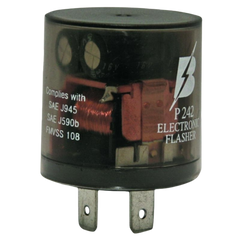
24V 3 pin flasher relay with DIN 72552 pin layout and 6.3mm blade terminals, front angle on transparent background

Elevate Automotive

24V 3 Pin Flasher Relay — 20A Electromechanical for Trucks & Buses

P243

24V 3-pin electromechanical flasher relay for truck, bus, caravan, and trailer indicator and hazard circuits. Drives up to 10 × 21W filament globes with a dash pilot output. Fits DIN 72552 flasher sockets.

Rated 20A at 24V DC
Up to 10 × 21W globes
3 pins · DIN 72552

$37.50$45.00 Save $7.50

4 interest-free payments of $9.38 with
or finance your build with
We accept
Universal 24V fitment24V 3-pin electromechanical flasher for indicator and hazard warning systems in heavy vehicles.

Shipping & collection

Worldwide shipping available*
In-store pickup
Professional installation available

*Shipping is calculated at checkout based on your location. Some products can't be delivered to every address.

A 24V 3-pin flasher relay that drives the indicators and hazards on heavy vehicles. Puts out around 60 to 120 flashes a minute to standard 21W globes and feeds a dash pilot lamp so the driver sees the circuit working. Fits 24V trucks, buses, caravans, trailers, and agricultural machinery with a DIN 72552 flasher socket.

Electromechanical construction with a thermal bimetal strip inside, switches up to 10 × 21W globes at 24V (210W total load) and runs down to a single globe without failing to cycle. Three pins follow DIN 72552 convention: pin 49 for the fused feed in, pin 49a to the indicator switch, and the pilot pin for the dash tell-tale lamp. Case is around 30 × 30 × 41mm with 6.3mm male spade terminals.

LED indicators draw too little current for the bimetal strip to heat and cycle properly, so install a dedicated load resistor on each corner or move to an electronic LED flasher if the vehicle has been retrofitted. A visibly slower flash signals a blown globe; treat that as a prompt to replace it rather than a fault with the relay.

Pairs with
  • 24V Rated
  • 10 × 21W Load — drives standard filament globes without resistors
  • Pilot Lamp Output — dash indicator shows the circuit flashing
  • Polarity Free — works in positive and negative ground vehicles
  • Thermal Bimetal — proven mechanical switching for commercial use
  • DIN 72552 Pins — slips into standard 3-pin flasher sockets
  • Blown Globe Signal — slower flash tells the driver a globe failed

Electrical

Voltage: 24V DC

Max Current: 20A

Max Load: 10 × 21W

Flash Rate: 60-120 FPM

Globe Type: Filament

Pin Count: 3

Pin Numbers: 49/49a/C

Physical

Dimensions: 30×30×41mm

Terminals: 6.3mm blade

Weight: ~40g

Op. Temp: -30 to +85°C
Length: 30mm

Width: 30mm

Height: 41mm

Weight: 0.12kg

24V 3-pin electromechanical flasher for indicator and hazard warning systems in heavy vehicles.
Fits 24V DC indicator and hazard circuits in trucks, buses, caravans, trailers, and agricultural machinery with DIN 72552 flasher sockets
Drives up to 10 × 21W filament globes at the one time (210W total load)
Not for LED indicators without a dedicated load resistor on each corner, LED current is too low to cycle the thermal strip
Not for 12V vehicle systems, the coil wont heat enough to switch at 12V
Not for trailer brake-light flashing, anti-theft flashing, or any application other than vehicle turn signals and hazards

Q: What does "3-pin flasher relay" mean?
A flasher relay cycles power to indicator globes to make them blink. The 3 pins are the fused feed in (pin 49), the output to the indicator switch (pin 49a), and the pilot lamp output (C) that drives the dash tell-tale lamp. A 2-pin version drops the pilot output.

Q: Will this work with LED indicators?
Not without help. The thermal bimetal strip inside needs a specific minimum current to heat and cycle, and LEDs draw a fraction of what a 21W filament globe pulls. Fit a dedicated load resistor on each corner (effectively faking the load of a globe) or move to a purpose-built electronic LED flasher.

Q: What's the difference between electromechanical and electronic flashers?
Electromechanical units use a heated bimetal strip that bends to open and close the contacts, producing an audible click. Electronic units use a solid-state timer circuit. Electromechanical flashers are forgiving of load variations within their range and are often preferred in commercial trucks because they signal a blown globe through a slower flash rate.

Q: What are the three pins, and what does each do?
Using DIN 72552 numbering: pin 49 takes the fused ignition-switched feed from the vehicle; pin 49a sends the pulsed output to the indicator stalk; and the pilot pin (sometimes marked C) drives the dash pilot lamp so the driver can see the circuit flashing.

Q: Can I use this in both positive and negative ground vehicles?
Yes. The flasher is not polarity sensitive so it fits either ground convention, which matters on older military, agricultural, and vintage commercial trucks that may still be positive earth.

Q: What does "10 × 21W globes" mean for my setup?
It names the maximum simultaneous filament load the flasher can switch. A typical heavy vehicle runs 2 front indicators, 2 rear indicators, 1 side-repeater per side, and sometimes 1 trailer per side at 21W each. Add them up for each turn direction (front + side + rear + trailer on one side) and keep the total under 210W. For hazards the total is both sides at once, so halve the per-corner budget.

Q: Will the flash rate change if a globe blows?
Yes, intentionally. A missing globe lowers the current through the bimetal, so the strip takes longer to heat and the flash slows noticeably. That is the built-in warning that a globe has failed, replace it and the rate returns to normal.

Q: How is this different from the 2-pin version?
The 2-pin variant has only the feed and output pins and no pilot lamp output, so the dash tell-tale is driven off the indicator switch circuit instead. The 3-pin version adds a dedicated pilot output which some vehicles need for a working dash indicator. If the vehicle's wiring diagram or original flasher called out a 3-pin socket, use the 3-pin.

Q: Can I use this to flash my brake lights or an alarm circuit?
No. This flasher is designed for turn signals and hazard warning only. Brake-light flashers for trailers use purpose-built modules with their own switching logic, and alarm flashers use low-current solid-state units. Using an indicator flasher for either will shorten its life.

Q: Does the pilot lamp pin need a globe installed?
No, the pilot output just needs to go somewhere, usually the dash tell-tale globe. If the vehicle has no dash pilot lamp wired, the pin can be left disconnected (though a 2-pin flasher is cleaner for that case).

Q: How do I wire the three pins?
Fused ignition-switched 24V to pin 49. Pin 49a goes to the common of the indicator switch (which then feeds left or right indicator circuits). Pilot pin (C) feeds the dash tell-tale globe to earth. Use at least 1.0mm² wire on the feed and output, and fuse the feed at 15A to protect the circuit upstream of the relay.

Q: Is this unit waterproof?
No, it is dash-mount or in-cabin rated only, not sealed against water, dust, or spray. Mount under the dash, in the fuse-panel bay, or behind an interior trim panel, not under the chassis or exposed to the elements.

Join our community.