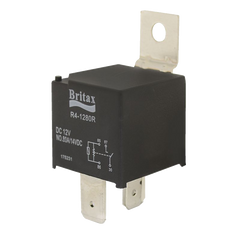
Q: What does changeover (C/O) actually mean?
A changeover relay has three load contacts, not two. Energise the coil and the common contact flips from the normally-closed side to the normally-open side; drop the coil and it flips back. That lets one trigger switch two circuits in opposite directions, powering one off while powering the other on, in the same motion.
Q: What is the difference between a micro relay and a mini relay?
Micro relays use the ISO 7588 micro pattern (also called 280 series) with 2.8mm blade terminals in a 15mm square housing. Mini relays use the ISO 7588 mini pattern (480 series) with 6.3mm blades in a 25mm square housing. Micro is smaller and lighter but tops out around 30A per contact; mini runs higher currents and is standard for 40A to 80A auxiliary switching. Pick micro where space is tight and current is under 30A.
Q: What does resistor protected mean?
There's a resistor wired across the relay's coil inside the housing. When the coil's supply drops, the magnetic field collapses and the coil tries to dump that energy as a high-voltage spike (back-EMF, often 150 to 200V on a 12V coil). The resistor absorbs most of that spike before it travels back up the trigger wire, which protects any solid-state device driving the relay, such as ECUs, LED controllers, PLCs and timers.
Q: Which socket fits this relay?
Any standard ISO 7588 micro relay socket, also sold as 280 series or micro ISO socket. The pin layout is 5 × 2.8mm blade terminals on the micro-ISO footprint. Narva, Hella and Jaycar all sell matching sockets, as do most automotive wholesalers under their own brand.
Q: Can I use it on 24V?
No. This is a 12V coil only. Putting 24V across a 12V coil draws roughly 4× the designed current and burns the coil out, usually within seconds. For 24V trucks and heavy vehicles, choose a 24V-coil micro relay.
Q: Why is the NO contact rated higher than the NC contact?
Normally-open contacts take the force of the armature flipping forward under spring tension when the coil energises, and they settle in with that same spring pressure. Normally-closed contacts only hold position passively (gravity plus a weaker spring). Higher-force contacts carry more current without arcing, which is why NO is usually rated higher than NC on changeover relays.
Q: Do I still need to fuse the switched circuit?
Yes. The relay switches the circuit on and off; it does not protect it. Fuse the switched load at the source based on the actual accessory draw (not the relay's rating). A 25A fuse covers most driving-light bars; a 30A fuse covers most horns and small motors. The relay is the switching element, the fuse is the overcurrent protection, and both are required.
Q: Where does the trigger wire go?
Pins 85 and 86 are the coil (trigger). Put 12V on 86 and ground 85 to energise the relay. Pin 30 is the common supply (connect to the switched circuit's main feed). Pin 87 is the normally-open output (powered when the relay is energised). Pin 87a is the normally-closed output (powered when the relay is OFF, cut when the coil is energised).
Q: Is it waterproof?
No. The housing is unsealed micro-ISO plastic. Mount it in a dry location, such as inside the vehicle cabin, inside a sealed junction box, or inside an auxiliary fuse box with a lid. Direct exposure to spray or wash-down shortens its life.
Q: How long will it last?
Rated for approximately 500,000 switching cycles at nominal current. At 20 switches per day that's roughly 70 years of service; at 100 switches per day about 14 years. Faster failure modes come from overcurrent (above rating), hot environments (above about 85°C ambient), or vibration-induced contact bounce.
Q: Can I use it as a split charger between two batteries?
No. A split-charge path for auxiliary batteries typically draws 100A or more during initial charging, which is 3× this relay's rating. Use a dedicated battery isolator or a DC-DC charger for split-charging; this micro relay is sized for signal and small-accessory switching, not current paths between batteries.
Q: How does this compare to a Narva 68080 or Tridon TR039PAC?
The Narva and Tridon micro-ISO equivalents are rated 20A on NO and 10A on NC; this Britax is rated 30A on NO and 25A on NC on the same micro pattern. Pick this one when the switched load sits in the 20 to 30A range (small motor, horn, driving light pair, small fan) where a 20A micro would be marginal. The Narva and Tridon are better suited for signal and lower-current switching.