EA-Logo-RGB-Master_Yellow-Dark-Grey-Black


Currency

Cart 0

SIGN UP FOR $10 OFF YOUR FIRST ORDER

Sorry, looks like we don't have enough of this product.

Pair with
Estimate shipping
Add order notes
Is this a gift?
Subtotal Free
View cart
Shipping, taxes, and discount codes are calculated at checkout

Your Cart is Empty

Home / Lighting / Driving & light bars
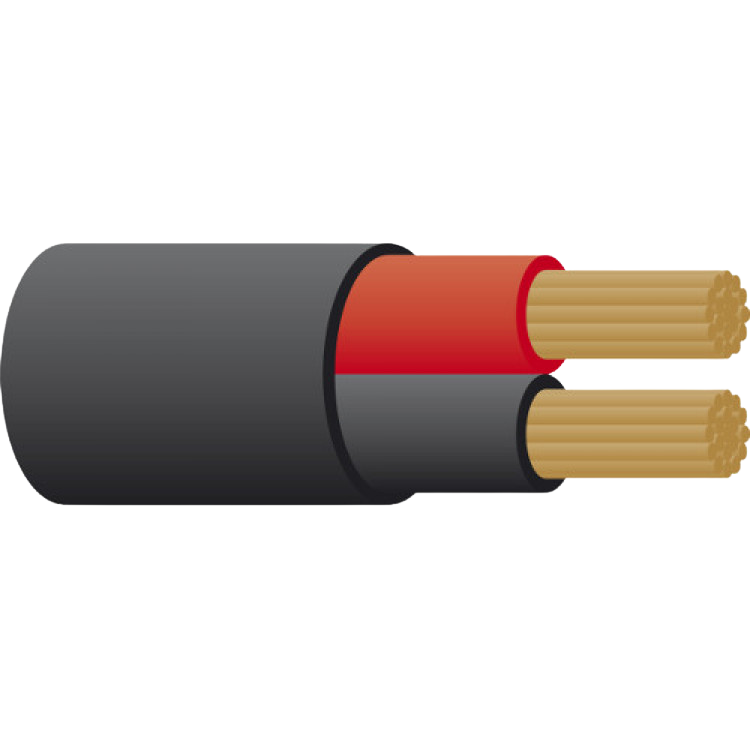
Twin core B&S battery and starter cable coil, black sheath with red and black inner cores

Elevate Automotive

Series of B&S Twin Core Cable Black Sheath (Black & Red inside)

CB106A2-050BKRD

Australian-made twin-core battery and starter cable in 6 B&S and 8 B&S, black sheath with red/black inner cores. V90 PVC insulated, sold per metre.

59.2 to 82.4A rated
6 B&S · 8 B&S
V90 PVC · 90°C

$23.50

4 interest-free payments of $5.88 with
or finance your build with
Size
We accept
Universal fitmentTwin-core battery and starter cable for dual-battery systems, auxiliary power circuits and DC-DC charger main links, 4WDs, caravans, RVs and marine.

Shipping & collection

Worldwide shipping available*
In-store pickup
Professional installation available

*Shipping is calculated at checkout based on your location. Some products can't be delivered to every address.

Twin-core battery and starter cable in 6 B&S and 8 B&S, with a black outer sheath and red/black inner cores so the positive and negative run together as one cable, suited to dual-battery wiring, DC-DC charger main links and other 12V/24V auxiliary power circuits.

Manufactured in Australia from oxygen-free copper to AS/NZS 1125, with V90 PVC insulation to AS/NZS 3808. Bundling two full-size conductors under one sheath keeps runs tidy and polarity obvious, instead of routing and clipping two separate single-core cables.

Size guide, which B&S do I need?

Twin-core cable carries less current than the same B&S size in single-core, because two conductors sharing one sheath generate more heat than the sheath can shed. Size on the twin-core rating below, not a single-core chart.

Size Cross-section (per core) Current rating* Typical use
6 B&S 13.5 mm² 82.4A DC-DC charger main link, dual-battery systems, higher-draw auxiliary circuits
8 B&S 7.71 mm² 59.2A Standard dual-battery wiring, fridges, lighter auxiliary power runs

*Continuous current rating at 30°C ambient, twin-core derated. Rating is a thermal limit, not a voltage-drop limit, for long runs, voltage drop can call for a heavier gauge than the current rating alone suggests.

Need a different size?

For light-duty runs, interior lighting, sensor feeds, low-draw accessories, the lighter 3mm to 6mm twin core range is a better and cheaper fit than full B&S gauge.
  • Australian-made — oxygen-free copper, AS/NZS 1125
  • V90 PVC insulation — AS/NZS 3808 compliant
  • Twin-core construction — positive and negative in one sheath
  • Fine-strand copper — flexible for tight routing
  • Two B&S sizes — 6 B&S and 8 B&S, per metre
  • Black outer sheath — red and black inner cores

Conductor

Material: Oxygen-free copper (AS/NZS 1125)

6 B&S strands: 168 x 0.32mm

8 B&S strands: 96 x 0.32mm

Insulation & sheath

Insulation: V90 PVC (AS/NZS 3808)

Configuration: Twin core, black sheath, red/black inner cores

Current rating (twin-core, derated)

6 B&S (13.5mm²): 82.4A @ 30°C

8 B&S (7.71mm²): 59.2A @ 30°C

Electrical resistance

6 B&S: 1.4 Ω/km @ 20°C

8 B&S: 2.4 Ω/km @ 20°C

Twin-core battery and starter cable for dual-battery systems, auxiliary power circuits and DC-DC charger main links, 4WDs, caravans, RVs and marine.
12V and 24V DC systems
Not designed for AC/mains wiring

Q: What does B&S actually mean?
B&S stands for Brown & Sharpe, the wire gauge system used for Australian battery and starter cable, the same role AWG plays for lighter automotive wire. Lower B&S number = thicker conductor = more current capacity. 6 B&S is thicker than 8 B&S.

Q: What's the difference between 6 B&S and 8 B&S?
6 B&S has a 13.5mm² conductor rated to 82.4A twin-core. 8 B&S has a 7.71mm² conductor rated to 59.2A twin-core. Choose on the actual current your circuit draws and the run length, see the size guide above.

Q: Why is twin-core rated lower than single-core of the same B&S size?
Twin-core bundles two full-size conductors inside one shared sheath. That concentrates heat in a smaller space than two separately-run single cables, and the sheath can't shed it as fast, so the safe continuous current is lower for the same conductor size. Always size from a twin-core rating table, not a single-core one.

Q: Is this cable sold by the roll or by the metre?
Sold per metre. Add the length you need in quantity, no minimum, no fixed roll size.

Q: Can I use this for a DC-DC charger's main battery link?
Yes. For most 20-40A DC-DC chargers, 6 B&S twin core comfortably covers the main battery-to-battery link over typical dual-battery run lengths. For longer runs or bigger chargers, check the charger manufacturer's cable-size recommendation against the current rating above, voltage drop over distance is often the limiting factor before current rating is.

Q: What terminals fit this cable?
6 B&S and 8 B&S need lugs sized to match, a 6 B&S lug won't crimp properly onto 8 B&S cable or vice versa. Match the lug barrel to the actual cross-section (13.5mm² for 6 B&S, 7.71mm² for 8 B&S), since lug sizing labelling varies between suppliers.

Q: Is this cable OK for marine use?
This is plain (non-tinned) copper cable, not tinned marine-grade. It suits dry, protected runs, engine bay, cabin, caravan wiring compartments, boat interiors away from bilge water. For exposed bilge or saltwater-spray installations, tinned-copper cable resists corrosion significantly better over time than plain copper.

Q: What temperature range does this cable handle?
V90 PVC insulation is rated for continuous operation up to 90°C at the conductor, per AS/NZS 3808, comfortably covers engine bay and cabin mounting.

Q: Does the current rating account for cable run length or voltage drop?
No, the amp rating is a thermal limit (how much current the cable can carry continuously without overheating), not a voltage-drop limit. Over a long run, voltage drop can call for a heavier gauge than the current rating alone suggests, sizing up for battery-to-battery links longer than a couple of metres is common practice.

Q: When do I need full B&S cable instead of the lighter 3mm-6mm twin core range?
3mm to 6mm twin core suits light-duty circuits, interior lighting, sensor feeds, low-draw accessories. Once you're wiring a DC-DC charger's main battery-to-battery link, or anything drawing more than about 30-40A over more than a couple of metres, you need 6 B&S or heavier, that's outside the lighter twin-core range.

Join our community.