Q: What does ‘continuous duty’ actually mean?
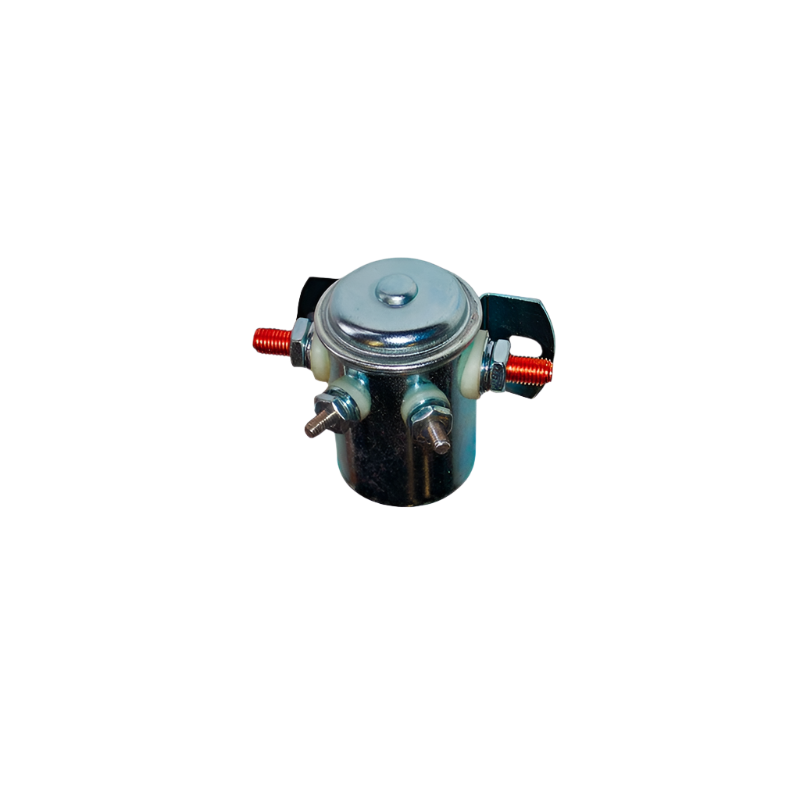
It means the coil can stay energised 24/7 without overheating. A standard automotive relay has an intermittent coil designed to be energised in short bursts (indicators, horn, starter crank). A continuous-duty solenoid like this one is built to hold the contacts closed for hours or days at a time, which is what you want for battery isolation, winch standby, or an always-on auxiliary circuit.
Q: What is the difference between a solenoid and a relay?
Functionally the same (small coil switches a big contact), but a solenoid is physically larger, uses a moving-disk or plunger contact, and handles far higher current than a typical relay. A mini relay handles 20-40A continuous; this solenoid is built for 100A continuous. For winches, inverters above 1000W, and battery-to-battery feeds, the solenoid is the right part.
Q: Will this work on a 12V system?
No. The coil is wound for 24V and will not pull in the contacts reliably from a 12V supply. Use the 12V version of this solenoid for 12V vehicles. Running a 24V coil on 12V doesn’t damage it, but the contacts will chatter or stay open and the circuit won’t switch.
Q: Can I use this as a winch solenoid?
For 24V winches drawing under 100A continuous, yes. Most 24V truck-mount winches peak well above 100A under heavy load (common ratings are 200-500A), so for those use a purpose-built heavy-duty winch contactor rated to the winch’s stall current. This solenoid is suited to lighter 24V winches, electric capstans, trolling motors, and auxiliary motor loads under 100A.
Q: What size cable do I need for 100A?
At 24V DC over a short run (under 2m) use 6mm² (approximately 10 AWG) cable for 100A, with correctly rated battery lugs. Longer runs step up to 8mm² or 10mm² to control voltage drop. Fuse the main load at the battery with an appropriately rated MIDI, MEGA, or ANL fuse (typically 125A for a 100A continuous load).
Q: Does this need a fuse?
Yes. Any permanent battery connection needs over-current protection at the battery end. The solenoid itself is not a fuse; it switches a circuit on and off but will not protect against a short in the downstream wiring. Fit a MIDI, MEGA, or ANL fuse rated 10-25% above your expected continuous load, as close to the battery positive terminal as practical.
Q: What does SPST normally open mean?
Single Pole Single Throw, Normally Open. One contact, one switching position, and it sits open (circuit disconnected) when the coil is not energised. Apply 24V to the coil and the contact closes, completing the load circuit. Remove the 24V signal and the contact springs back open. The load is live only while the control signal is present.
Q: How much current does the coil draw?
For a 24V continuous-duty solenoid, coil draw is typically 150-250mA at 24V DC when energised, so budget around 0.2A continuously on the control circuit. This is low enough to run through a standard dash switch, an ignition circuit, or a low-current winch controller output without any intermediate relay.
Q: Can it handle inrush peaks above 100A?
Brief inrush peaks on motor loads (first few hundred milliseconds) are tolerated well above the continuous rating. Sustained loads above 100A, however, will burn the contacts and the coil will not help; the limit is thermal, not switching. Keep continuous load under 100A and let short motor inrush spikes do what they do.
Q: Is this the right part for a dual-battery setup?
For simple paralleling (ignition-triggered battery isolation on a 24V vehicle) it works well as a voltage-sensitive isolator alternative. For modern dual-battery setups where the auxiliary battery charges from a smart DC-DC and separates automatically, use a purpose-built 24V DC-DC charger instead; it handles both the isolation and the correct charge profile for AGM or lithium auxiliaries.
Q: Grounded coil or isolated coil, which is this?
This unit uses a case-grounded coil, so one end of the coil is bonded to the solenoid body through the mounting bracket. Mount it to clean bare metal that is bonded to the vehicle chassis, or run a dedicated earth wire from the mounting bolt to a known-good chassis ground. If a fully isolated-coil solenoid (both coil terminals electrically isolated from the case) is needed for a floating 24V system or marine installation, note that this is not that version.
Q: Will the solenoid get hot when the coil is on continuously?
Slight warmth at the case is normal (the coil dissipates around 4-6W when energised at 24V), but it should never be too hot to touch. If the body gets hot enough to burn, the coil is likely being fed above 24V nominal (e.g. 28V alternator output pushed through a bad regulator) or the duty-cycle rating has been exceeded. Check the supply voltage at the coil terminal and the mounting ventilation.