Q: What does 'SPST' actually mean on a battery isolator?
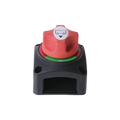
Single Pole, Single Throw. One wire in, one wire out, one lever that opens or closes that single circuit. Think of it as a plain on/off tap for the main battery cable. It is not a selector that chooses between two batteries, and it is not a cutout that trips automatically. You flick it, the circuit is live; flick it back, the circuit is dead.
Q: What does '200A continuous' cover?
That is the current the contacts will carry all day without heating up or welding. In practical terms it covers almost any 4WD, caravan or boat accessory load: a 2000W inverter at 12V draws around 200A at full tilt, a winch under moderate pull sits around 150A to 200A, and a mixed accessory bank with fridge, lights and charger draws well under 100A. Short cranking surges above 200A are tolerated briefly but are not what the switch is rated for continuously.
Q: What is the difference between this and the Baxters 125A/300A master switch with the removable key?
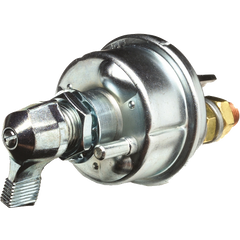
Two different jobs. This 200A lever switch is a plain mechanical on/off for an auxiliary or main battery feed; the lever stays put but is not lockable. The pin-locator switch pulls out a key when it is in the off position, which locks the vehicle in a disconnected state for workshop service or anti-theft. If you need a lockout for compliance or security, use the pin-locator. If you just want a cheap, reliable disconnect you can throw by hand, this one does the job: [battery-master-switch-off-on-with-pin-locator]
Q: Is this suitable for lithium batteries?
Yes, as a main disconnect on the output side of the BMS. Lithium chemistry does not change what a mechanical switch does, as long as the current and voltage are within rating. Do not use this switch to break current while the lithium pack is sinking a surge above 200A continuous: size the switch to the actual steady-state draw, not the pack's peak capability.
Q: Can I use it to isolate dual batteries?
Only as a plain disconnect on one of the two batteries. It cannot select between batteries. For a dual-battery setup where you want to run from Battery 1, Battery 2 or Both, use a 4-position battery selector switch instead. If you just want to disconnect the auxiliary battery for storage or service, fit one of these on the auxiliary main feed.
Q: Can it be used in marine applications?
Yes for interior installs: behind a helm panel, inside a battery box or in a dry locker. The contacts and body are suited to the vibration and voltage range of a boat's DC system. We do not have a published IP rating from the supplier so do not install it on an exposed deck or in a bilge where it will see spray or standing water. Mount it under cover.
Q: What size cable and lug do I need?
The studs are M10 so you need a ring lug with a 10mm hole. For a true 200A continuous feed, run 00 B&S / 70mm² copper cable minimum; for shorter runs or lower sustained loads, 2 B&S / 35mm² handles up to around 150A at short length. Always size cable to the load and the run length, not just the switch's maximum. See: [00b-s-single-core-battery-cable-black-sheath]
Q: Does it need its own fuse?
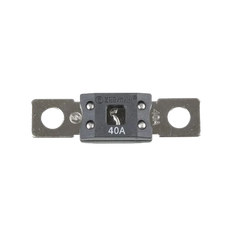
Yes, fit a main fuse at the battery post upstream of the switch. The switch is a disconnect, not an overcurrent device: if the cable downstream shorts, the switch will happily pass thousands of amps and weld its contacts closed. Match the fuse to the cable size: MEGA 100A for 2 B&S, 150A for 1 B&S, 200A for 1/0 B&S, 300A for 00 B&S. See: [series-of-mega-fuse]
Q: How do I mount it?
Cut a 55mm hole in the panel for the body, then use the four corner holes in the base to screw it to the panel face. The lever stays on the outside, the stud terminals project through to the back. Keep the terminals clear of other metal; a plastic terminal cover is cheap insurance against accidental shorts from dropped tools.
Q: Will it switch 240V mains?
No. The contacts are rated for DC only. 240V AC mains work in Australia is a licensed electrician's job under AS/NZS 3000. Elevate holds EC17073 (Building & Energy WA) if you need mains work done; use a mains-rated isolator for AC circuits, not this one.