EA-Logo-RGB-Master_Yellow-Dark-Grey-Black


Currency

Cart 0

SIGN UP FOR $10 OFF YOUR FIRST ORDER

Sorry, looks like we don't have enough of this product.

Pair with
Estimate shipping
Add order notes
Is this a gift?
Subtotal Free
View cart
Shipping, taxes, and discount codes are calculated at checkout

Your Cart is Empty

Home / Lighting / Driving & light bars
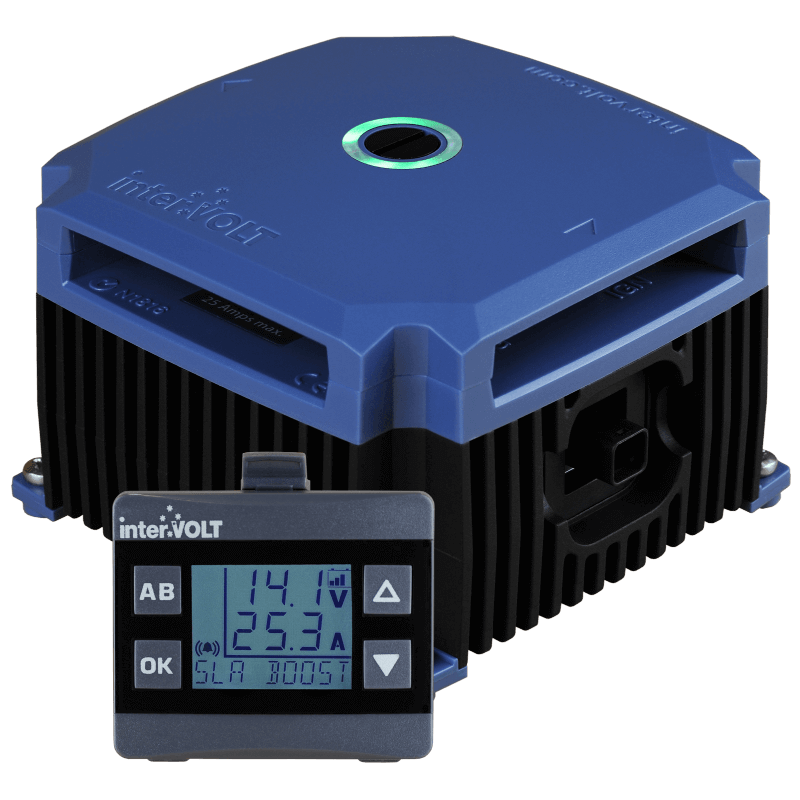
Intervolt DCC Pro 25A DC-DC charger (DCC1225ACK-RP) hero shot showing the IP67 sealed grey housing with heatsink fins, Intervolt branding, and terminal label plateIntervolt DCC Pro remote in-cabin display showing live main battery, auxiliary battery and solar input status for one or two DCC Pro chargersIntervolt DCC Pro wiring diagram showing main battery feed with 40A fuse, auxiliary battery output with 30A fuse, solar panel input direct to MPPT, and ignition control input

Intervolt

DCC Pro — 25A DC-DC Charger with MPPT Solar + Remote Display

DCC1225ACK-RP

25A DC-DC charger with built-in MPPT solar input and in-cabin remote display, IP67 sealed and designed and built in Perth for 4WDs, caravans and campers running lead-acid, AGM, gel, calcium or LiFePO4-BMS batteries.

$609.00

4 interest-free payments of $152.25 with
or finance your build with
We accept
Universal 12V DC fitmentIn-vehicle multi-stage charger for 12V auxiliary battery banks

Shipping & collection

Worldwide shipping available*
In-store pickup
Professional installation available

*Shipping is calculated at checkout based on your location. Some products can't be delivered to every address.

A 25A DC-DC charger with built-in MPPT solar input that charges an auxiliary bank from the alternator and roof panels at the same time. Fits 4WDs, caravans, campers, boats and ambulances running one-house-battery or dual-house-battery setups. Pairs with lead-acid, AGM, gel, calcium or LiFePO4 (BMS-equipped) banks.

The housing is IP67 sealed for under-bonnet mounting and runs between -20°C and +85°C ambient, with 25A continuous output to 50°C and a derate curve above that. A 4-metre data cable runs to an in-cabin remote display that shows live main-bank, aux-bank and solar status; one display can toggle between two DCC Pro units. Designed, engineered and built in Perth, Western Australia.

Fuse the main battery feed at 40A and the auxiliary output at 30A within 300mm of each terminal, and run 6mm² (8 B&S) cable up to 5-metre runs or 10mm² (6 B&S) between 5 and 9 metres. Solar panels wire straight to the solar input, no external regulator; if the panels already run through a controller, bypass it before wiring here.

What sets it apart

Dual-source charging — alternator and solar simultaneously

Built-in MPPT regulator — no external solar controller needed

25A continuous at 50°C — rated for Australian under-bonnet heat

IP67 sealed housing — dust and water tight for engine bay

Multi-chemistry support — lead-acid through LiFePO4 BMS

In-cabin remote display — live main, aux and solar status

Dual-unit monitoring — one display runs two DCC Pros

Mounting and install

Mount the DCC Pro on a hard flat surface with 30mm clearance on all sides for airflow around the heatsink. The charger housing is IP67 sealed so under-bonnet mounting is fine, but the remote display is only IP40 and belongs inside the cabin or a sealed canopy. Use all four anchor holes and orient the status LED so you can see it when the bonnet is open.

Default control mode is voltage-sensing (starts above 13.0V, holds standby below 12.6V), which suits conventional vehicles. For stop-start, smart-alternator or ECU-controlled vehicles, switch to Ignition mode and tie the control input to switched ignition. The included 4-metre data cable runs the remote display from the charger to the cabin.

Pairs with
  • Dual-source charging — alternator and solar simultaneously
  • Built-in MPPT regulator — no external solar controller needed
  • 25A continuous at 50°C — rated for Australian under-bonnet heat
  • IP67 sealed housing — dust and water tight for engine bay
  • Multi-chemistry support — lead-acid through LiFePO4 BMS
  • In-cabin remote display — live main, aux and solar status
  • Dual-unit monitoring — one display runs two units
  • Full protection suite — reverse polarity, over-temp, over-voltage

Electrical

Main Input: 9–16 VDC

Solar Input: 18–28 VOC

Solar Power: Up to 250W

Output (cont.): 25A @ 50°C

Boost Mode: Up to 35A

Operating Temp: -20°C to +85°C

Chemistry support (boost)

Lead Acid: 14.4V boost

AGM: 14.7V boost

Gel: 14.3V boost

Calcium: 14.9V boost

LiFePO4 BMS: 14.6V single

Fuses (minimum)

Main Battery: 40A

Auxiliary: 30A

Solar Panel: Per panel

Protection

Reverse Polarity: All terminals

Over-Temp: Auto reset

Over-Voltage: Auto reset

Under-Voltage: Auto restart

Build

IP Rating: IP67 (device)

Display IP: IP40 (cabin)

Made in: Perth, Australia
Length: 112mm

Width: 112mm

Height: 75mm

Weight: 0.69kg

Mount the DCC Pro on a hard flat surface with 30mm clearance on all sides for airflow around the heatsink. The charger housing is IP67 sealed so under-bonnet mounting is fine, but the remote display is only IP40 and belongs inside the cabin or a sealed canopy. Use all four anchor holes and orient the status LED so you can see it when the bonnet is open.

Fuse the main battery feed at 40A within 300mm of the start battery, and fuse the auxiliary output at 30A within 300mm of the aux battery. Cable sizing is 6mm² (8 B&S) for runs under 5 metres and 10mm² (6 B&S) between 5 and 9 metres. Solar panels wire directly to the solar input with no external regulator; if the panels already have a controller, bypass it before wiring here.

Default control mode is voltage-sensing (starts above 13.0V, holds standby below 12.6V), which suits conventional vehicles. For stop-start, smart-alternator or ECU-controlled vehicles, switch to Ignition mode and tie the control input to switched ignition. The included 4-metre data cable runs the remote display from the charger to the cabin.

In-vehicle multi-stage charger for 12V auxiliary battery banks
4WDs, utes, vans, caravans, campers, boats and ambulances
Smart-alternator and stop-start vehicles (set control to Ignition mode input)
Lead-acid, AGM, gel, calcium, and LiFePO4-with-BMS banks
24V vehicle systems: Main input accepts 9–16 VDC only, use a 24V-input DC-DC
Non-BMS lithium chemistries (LCO, NMC): only LiFePO4 with built-in BMS is supported

Q: What does DC-DC mean on a battery charger?
A: DC-DC means direct-current-to-direct-current. The DCC Pro takes the 12V from the start battery or alternator and converts it to a precisely controlled charging voltage for the auxiliary battery, so the aux bank gets a proper multi-stage charge instead of just whatever the alternator happens to be outputting that moment.

Q: What is MPPT and why does the DCC Pro need it?
A: MPPT stands for maximum power point tracking. It is the solar regulator that reads panel voltage and current many times a second and holds the panel at its most efficient operating point, so you get more amps out of the same panel than a simple PWM regulator. Because the DCC Pro has an MPPT built in, you wire solar panels straight to its solar input without a separate controller.

Q: Can this charge LiFePO4 lithium batteries?
A: Yes, the R2.0 DCC Pro has a dedicated LiFePO4 BMS charging profile set at 14.6V single-stage. It only works with LiFePO4 batteries that have a built-in battery management system (BMS); it is not suitable for other lithium chemistries like LCO or NMC.

Q: What size cable and what size fuse should I use?
A: Fuse the main battery feed at 40A minimum and the auxiliary output at 30A minimum, with each fuse within 300mm of the battery it is protecting. For runs up to 5 metres use 6mm² (8 B&S) cable; for longer runs between 5 and 9 metres step up to 10mm² (6 B&S). Solar input fuse sits with the panel per its own rating.

Q: Can it mount under the bonnet?
A: Yes, the charger housing is IP67 sealed and rated for ambient temperatures from -20°C to +85°C. Mount it on a hard flat surface with at least 30mm clearance on all sides for airflow around the heatsink. The remote display is IP40 and belongs in the cabin, not out in the engine bay.

Q: Does it have an ignition input for smart-alternator vehicles?
A: Yes. The default control mode is voltage-sensing, which starts charging above 13.0V and drops to standby below 12.6V. For stop-start, smart-alternator or ECU-controlled vehicles that drop battery voltage below those thresholds while running, switch to Ignition mode and tie the control input to switched ignition. Two Ignition thresholds are selectable: NORMAL (12.0V cutout) and LOW (11.5V cutout for ECU vehicles).

Q: Can I wire my existing solar panel directly to this?
A: Yes, as long as the panel wires straight into the DCC Pro's solar input with no regulator in between. If your panel already runs through a PWM or MPPT regulator, bypass or remove that regulator before connecting to the DCC Pro. The solar input accepts up to 28V open-circuit (18V minimum under load) and up to 250W of panel.

Q: How does this compare to a Redarc BCDC Classic 50?
A: Both are MPPT-equipped DC-DC chargers. The Redarc BCDC Classic 50 delivers 50A continuous and is a step up in output for larger lithium banks; the DCC Pro delivers 25A continuous and ships with the in-cabin remote display and 4-metre data cable in the box. If you have a 100-200Ah lead-acid or AGM bank, 25A is the right size; for larger 200Ah+ LiFePO4 banks that want faster charging, step up to the Classic 50.

Q: What happens if it overheats or sees a wiring fault?
A: It has reverse-polarity protection on every terminal, plus over-temperature and over-voltage disconnects that auto-reconnect once conditions return to normal, and an under-voltage shutdown that auto-restarts. If charging drops out and then resumes on its own, that is the protection circuitry working as intended.

Q: Can I run two DCC Pros from one remote display?
A: Yes, one DCC0001ARD remote display monitors two DCC Pro units simultaneously. Toggle between them with a short press of the selector button; the display shows which charger is active. Useful on dual-house-battery setups where each bank has its own charger.

Join our community.